

In this article we’ll compare four cinema cameras all designed to appeal to the low budget cinema market.
Here are the cameras compared:
- Sony FX6 (Amazon, B&H)
- Canon EOS C70 (Amazon, B&H)
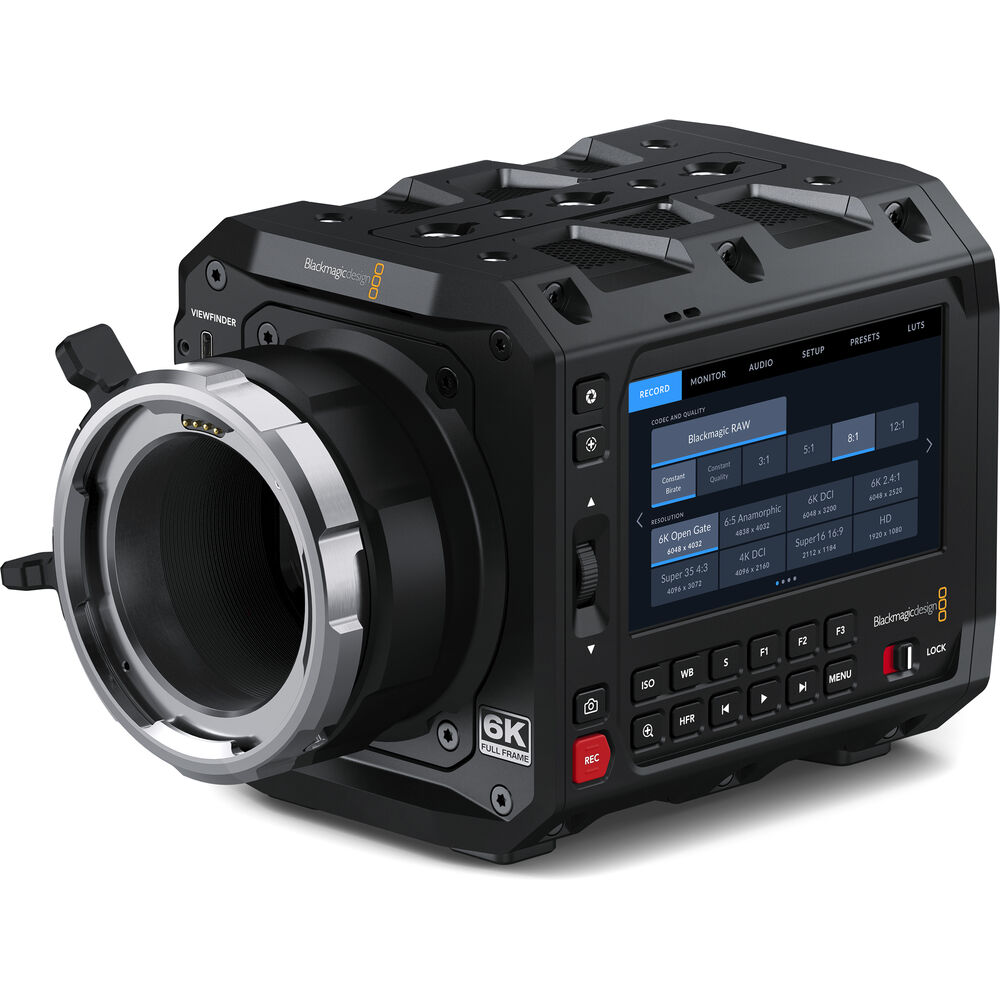
- Blackmagic Design PYXIS 6K (Amazon, B&H)
- Red Komodo-X
The PYXIS 6K is way cheaper than the others on this list, and it’s not really a fair fight. But what if the Blackmagic Design PYXIS 6K (Amazon, B&H) can deliver most of the value presented by the others?
That’s what I wanted to find out. Let’s get to it.

The Red Komodo-X has a global shutter, and this sets it apart from the others on this list. If you want to know how it stacks up against the Komodo, we did a comparison:
The camera body
Here’s how much the base camera body costs:
| Camera | Price of Camera Body |
| Sony FX6 | $5,998 |
| Canon EOS C70 | $4,999 |
| Blackmagic Design PYXIS 6K | $2,995 |
| Red Komodo-X | $9,995 |
You could buy about two Blackmagic Design PYXIS 6K (Amazon, B&H) cameras for the price of the FX6 or C70 (the price of the C70 has dropped since last year). You could buy three PYXIS 6K cameras for the price of the Red Komodo-X.
It’s always important to investigate and feel out the after-sales and service in your country or area prior to committing to any camera. No point in buying a camera and then having to pull your hair out when you realize you have to ship your camera overseas for repairs.
Let’s get started with the sensor and video features.
Comparison of sensors and video features
Sensor performance
Here’s how the camera sensors compare:
| Camera | Maximum Resolution | Sensor Size |
| Sony FX6 | 4096 x 2160 | 35.7 x 18.8 mm |
| Canon EOS C70 | 4096 x 2160 | 26.2 x 13.8 mm |
| Blackmagic Design PYXIS 6K | 6048 x 4032 | 36 x 24 mm |
| Red Komodo-X | 6144 x 3240 | 27.03 x 14.26 mm |
The Sony FX6 (Amazon, B&H) and the Blackmagic Design PYXIS 6K (Amazon, B&H) have full frame sensors while the others have Super 35mm sensors.
The size of the sensor is not an indicator of quality, only aesthetics. If you like the full frame look, then your choices get whittled down.
To know about the distinction read this:
Continuing with the specifications, let’s dig deeper:
| Camera | Dynamic Range* | ISO Range^ | Built-in ND | Shutter |
| Sony FX6# | 15+ | 800, 12800 to 409,600 | Yes, 2-7 stops | Rolling |
| Canon EOS C70 | 16+ stops | 100-102,400 | Yes, 2, 4 and 6 (8 & 10)^ stops | Rolling |
| Blackmagic Design PYXIS 6K | 13 | 100 to 25,600 | No | Rollling |
| Red Komodo-X | 16.5+ | 250 to 12,800 | No | Global |
*You can’t compare these dynamic range numbers directly because almost all of them fudge the numbers. None of these cameras can beat the Arri Alexa LF with a published 14+ stops of dynamic range – not where it matters anyway! However, going by my experience with some of these cameras, I’d say the PYXIS 6K does lag behind.
The cheaper Blackmagic Design sensors do have various issues in low light, with fixed pattern noise and poor rolling shutter. On the flip side, the color science and workflow is really cool.
^8 and 10 through using two NDs at the same time (6+2) and (6+4). Canon calls this extended mode.
#The Sony FX6 has 15+ stops dynamic range with 10% crop.
The Sony FX6 (Amazon, B&H) is definitely the best camera for low light, but the Canon EOS C70 (Amazon, B&H) is no slouch either. Both cameras have built-in ND filters.
The USP of the Red Komodo-X is that it is the only camera with a global shutter, same as the Red Komodo which costs much less than this.
The PYXIS 6K doesn’t win in any feature in this round.

Frame rates
Let’s look at frame rates:
| Camera | Max fps at 4K | Max fps at 1080p |
| Sony FX6 | 3840 x 2160 @ 120 fps* | 1920 x 1080 @ 120 fps** |
| Canon EOS C70 | 4096 x 2160 @ 120 fps | 2048 x 1080 @ 180 fps^ |
| Blackmagic Design PYXIS 6K | 4096 x 2160 @ 60 fps | 1920 x 1080 @ 120 fps |
| Red Komodo-X | 4096 x 2160 @ 120 fps | 2048 x 1080 @ 240 fps |
*In XAVC-S/L mode only, in UHD, not 4K DCI. In XAVC-I the maximum frame rate is 60 fps.
**The FX6 can do higher frame rates but less than 1080p resolution.
^180 fps is in 2K/Super 16mm mode.
The Red Komodo-X seems to be the most versatile camera in this list for high frame rate recording, narrowly beating the Canon EOS C70 (Amazon, B&H). Of course, the Komodo-X can go to a higher resolution as well.
The PYXIS 6K is disappointing here. We’re past the time when a camera could get away with 4K @ 60 fps. Even at a similar price point cameras like the Sony FX3 (Amazon, B&H) does 120 fps in 4K.
Codecs
| Camera | Internal RAW | External RAW* | Bit depth for RAW | Other Codecs |
| Sony FX6 | No RAW | ProRes RAW via HDMI | 16-bit^ | XAVC-I |
| Canon EOS C70 | Cinema RAW Light | No | 12-bit | XF-AVC, H.265/H.264 |
| Blackmagic Design PYXIS 6K | BRAW | No | 12-bit | None, H.264 only in proxy mode |
| Red Komodo-X | Redcode RAW | No | 12-bit | Prores HQ (up to 4KProres HQ (up to 4444 XQ) |
^Disregard the 16-bit bit depth on the Sony FX6, it’s probably just 12-bit rewrapped. It’s unlikely you’ll get true 16-bit for this price.
The Cinema Raw Light feature in the Canon EOS C70 (Amazon, B&H) makes it easier to handle RAW data rates, similar to BRAW and Redcode RAW.
The Red Komodo-X wins this one though because of the popularity of Redcode RAW and the options that it gives for ProRes.
What you get externally:
| Camera | Connection | Best resolution and fps | Audio |
| Sony FX6 | 12G SDI x1, HDMI x1 | 4264 x 2408 @ 60fps | UHD @120 fps^ | 2x XLR |
| Canon EOS C70 | HDMI x 1 | 4096 x 2160p @ 60fps | 2x Mini XLR |
| Blackmagic Design PYXIS 6K | 12G-SDI x1 | 2160p @ 60fps | 1x Mini XLR |
| Red Komodo-X | 12G SDI x1 | 4096 x 2160p @ 60fps | 5-Pin port |
One of the important distinctions of a cinema camera is the availability of additional SDI/HDMI ports for monitoring and recording.
The Sony FX6 (Amazon, B&H) clearly wins this round with two XLR inputs and both SDI and HDMI ports.

Lens mounts
Being cinema cameras, what mounts are on offer?
| Camera | Mounts | Price for PL mount |
| Sony FX6 | Sony E mount | $494* |
| Canon EOS C70 | Canon RF | $449* |
| Blackmagic Design PYXIS 6K | Leica L, Canon EF, Arri PL | $200** |
| Red Komodo-X | Canon RF | $449* |
**The PL-mount version costs $200 more.
Every camera offers a small flange focal distance option so you can adapt virtually any lens with a lens adapter.
If your goal is to end up with PL glass you need to factor in the additional cost for a lens adapter. If you do opt of the Leica L-mount option for the PYXIS 6K, you need to factor in the cost of an L to PL adapter. Blackmagic Design haven’t announced user swappable lens mount plates specifically for the PYXIS at the time of this writing.
Overall, the Blackmagic Design PYXIS 6K (Amazon, B&H) gives you the best options.
Autofocus performance
| Camera | Continuous Autofocus |
| Sony FX6 | Phase Detection AF with Eye Tracking |
| Canon EOS C70 | Dual Pixel CMOS AF |
| Blackmagic Design PYXIS 6K | Bare minimum |
| Red Komodo-X | Phase Detect and Contrast |
If autofocus is something you’re seriously considering, the Canon EOS C70 (Amazon, B&H) is your best bet. The dual pixel AF performance should beat everyone else on this list, especially if also decide to pair it with Canon EF lenses.
Monitoring and ergonomics
Weight and size
Let’s look at the weight and size:
| Camera | Volume (size) | Weight (Body Only) |
| Sony FX6 | 123 cubic inches | 890g |
| Canon EOS C70 | 147 cubic inches | 1.19 kg |
| Blackmagic Design PYXIS 6K | 116 cubic inches | 1.5 kg |
| Red Komodo-X | 78 cubic inches | 1.19 kg |
The Sony FX6 (Amazon, B&H) impresses with the number of features that it has packed in a relatively light body. The PYXIS, being a smaller camera, is the heaviest!
What about the LCD monitor? Some of the cameras have a monitor you can watch your footage on, and this is handy in a pinch. For serious monitoring, though, you need an external monitor that’s at least 5″.
All the cameras can be operated without a dedicated monitor or viewfinder.
| Camera | Monitor |
| Sony FX6 | 3.5” touchscreen |
| Canon EOS C70 | 3.5” touchscreen |
| Blackmagic Design PYXIS 6K | 4″ touchscreen |
| Red Komodo-X | 2.9″ touchscreen |
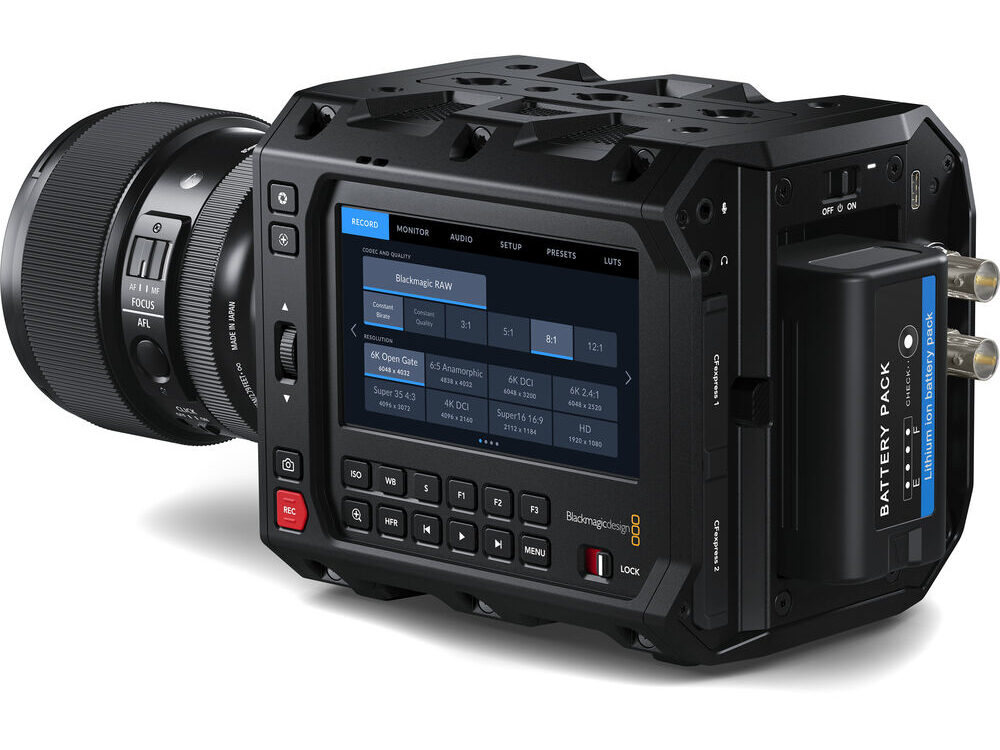
The monitor on the Blackmagic Design PYXIS 6K (Amazon, B&H) is stuck to the left and is not a practical solution for monitoring. Same goes for the monitor on the Red Komodo-X, which is on the top. It’s a little more practical, but the size makes it harder.
The monitor on the Sony FX6 (Amazon, B&H) can swivel in any direction, so it wins this round.
Media and Batteries
Media
Here’s a look at the media options:
| Camera | Card slots | Price (Price per GB) |
| Sony FX6 | 2x CFexpress Type A / SD card | $838 ($1.30/GB) |
| Canon EOS C70 | 2 x SD UHS-II | $150 ($0.29/GB) |
| Blackmagic Design PYXIS 6K | 2 x CFexpress Type B card slot, 1 x USB-C 3.1 Gen 1 | $140 ($0.27)* |
| Red Komodo-X | 1 x CFexpress Type B | $399 ($0.38)^ |
^RED DIGITAL CINEMA 2TB PRO CFexpress 2.0 Type B Memory Card.
You also have to factor in the actual data required:
| Camera | Best Internal Codec | Data rate* | Cost per 4 hours |
| Sony FX6 | XAVC-I | 75 MB/s | $1,372 |
| Canon EOS C70 | Cinema RAW Light | 81 MB/s | $330 |
| Blackmagic Design PYXIS 6K | BRAW | 140 MB/s^ | $532 |
| Red Komodo-X | Redcode RAW | 175 MB/s^ | $935 |
^In 8:1 setting, or MQ compression. Cinema RAW Light is about 3:1 to 5:1.
Both the Blackmagic Design PYXIS 6K (Amazon, B&H) and the Canon EOS C70 (Amazon, B&H) are great value, and on the whole I’d give it to the C70 because the reader is more ubiquitous and cheaper.
What about battery life?
Batteries and Power
| Camera | Battery | Power Draw | Battery Voltage |
| Sony FX6 | Sony BP-U70 | 18 W | 19.5V |
| Canon EOS C70 | Canon BP-A30 | 14.6 W | 14.4V |
| Blackmagic Design PYXIS 6K | Sony BP-U70 | Not published* | 12V |
| Red Komodo-X | Micro V-Lock | 24 W | 14.4V |
Now all we have to do is find the battery life and cost of operation for 6 hours of a day’s worth of work.
Here are the numbers:
| Camera | Battery life^ | Watt hours | Cost | Cost of 6 hours of operation |
| Sony FX6 | 210 mins | 72 Wh | $318 | $545 |
| Canon EOS C70 | 130 mins | 45 Wh | $229 | $634 |
| Blackmagic Design PYXIS 6K | 100 mins | 72 Wh | $318 | $1,144 |
| Red Komodo-X | 60 mins | 49 Wh | $275 | $1,650 |
The Komodo-X is very power hungry, and the wattage I’ve taken into account is when the LCD isn’t attached. If it is, the power draw is 45 Watts, so double the cost (half the run time).
Time to sum up everything.
Which is cheaper to own?
Shall we? It’s important to add accessories to put all cameras on an even keel:
| Camera | Sony FX6 | Canon EOS C70 | Blackmagic Design PYXIS 6K | Red Komodo-X |
| Camera body | $5,998 | $4,999 | $2,995 | $9,995 |
| Cost of Media | $1,372 | $330 | $532 | $935 |
| Cost of Batteries | $545 | $634 | $1,144 | $1,650 |
| Lens Adapter (PL) | $494 | $449 | $200 | $449 |
| Total | $8,409 | $6,412 | $4,871 | $13,029 |
The Red Komodo-X is the most expensive by a huge margin.
The price of the Canon EOS C70 (Amazon, B&H) has been dropped recently and it definitely has a leg up over the Sony FX6 (Amazon, B&H). The PYXIS 6K, though, is a lot more expensive than you’d think on first glance.
The choice will come down to usability and exactly what kind of work you’re doing.

Verdict
First, a recap:
| Feature | Winner |
| Sensor, ISO and Low Light | Sony FX6 |
| Built-in ND filters | Canon EOS C70 |
| Frame Rates | Red Komodo-X |
| Codecs | Red Komodo-X |
| SDI and XLR | Sony FX6 |
| Variety of Lenses | Blackmagic Design PYXIS 6K |
| Autofocus | Canon EOS C70 |
| Media | Canon EOS C70 |
| Ergonomics | Sony FX6 |
| Battery life | Sony FX6 |
It’s a lot closer than it looks. Before we take our final decision, we’ll let each camera tell us what it offers that the other doesn’t:
| Camera | USP | Major Cons |
| Sony FX6 | Lightweight, low light performance, AF, 4K 120 fps externally, ND filter, XLR inputs, SDI and HDMI, ergonomics, worldwide availability and support | No RAW internally |
| Canon EOS C70 | Great value for money, ND filters, AF, Internal compressed RAW | Mirrorless style ergonomics, only HDMI |
| Blackmagic Design PYXIS 6K | Lens mounts, can use URSA EVF, built-in live streaming, price, Internal compressed RAW, Resolve Studio | Low light performance, weight, power draw, single mini-XLR input, fixed LCD screen, no ND |
| Red Komodo-X | Global shutter, 240 fps in 2K, Internal compressed RAW | No XLR for audio, power draw, no ND filter, single card slot, expensive |
If I had to pick one winner, I’d pick the Canon EOS C70 (Amazon, B&H). You can pretty much handle any kind of production with this camera as long as you are find with the Super 35mm format.
If I had to pick one just for full frame, the Sony FX6 (Amazon, B&H) would be my choice.
You really can’t beat the value proposition of both these cameras. The other cameras on the list really show their weaknesses when you compare it like this. E.g., the C70 is only about $1,500 more than the PYXIS 6K, but offers multiple advantages in all kinds of practical filmmaking. You’d easily recover it if you’re a working professional.
What do you think? Let me know in the comments below.

I’m sorry but this is a crappy comparison and poorly written article.
You’re a filmmaker yourself sir, yet you provide comparison of these cameras like a Best Buy salesman who usually handles Alexa aisle and has been temporarily put in the “cheap camera section” – and thus resorts to cookie cutter layman aspects.
1. You mention everyone fudges dynamic range, that no-one beats Alexa and move on to conclude that Pyxis lags behind! Sony’s dynamic range is the most fudged of them all. Blackmagic’s is the most realistic. I encourage you to play with them both. Ask someone who has an FX6 _and_ a Pyxis 6K.
2. You mention sensor is “all about aesthetics” and talk about “poor rolling shutter”. Yet you fail to mention that Pyxis has open gate. And yes, like the internet I was pleasantly surprised how much the rolling shutter did NOT matter outside of the lab tests. (including whip pans). I have not even had to use the Gyro stab yet!
3. You talk of Autofocus – tell me good sir, in you Amazon Prime movie did you actually use lenses that support autofocus?? What cinema lens worth its salt comes in autofocus. Are we comparing wedding shoot cameras?
3. You fail to mention that Sony cameras have in-built NR which gets clubbed with its “legendary” low light performance, but its a cheap gimmick that can’t compete with post production NR. In real life, outside the world of Alexa, you would be blown away by the low light performance of the non-sony underdogs.
You should treat yourself to the color explosion of Blackmagics or Reds to understand how utterly lacking and overhyped Sony is. (coming from someone who built a massive E mount ecosystem and is now trying to sell it).
5. Finally, again, I’m not surprised by your lack of mention of open gate – I kind of expected that after your lukewarm review of Atlas Orions, which to me are the most painterly artistic lenses I’ve used. But even Roget D hates anamorphs so to each his own I suppose :)
good day.
Great overview! The recent price drop of the RED Komodo / X and the arrival of the C400 could be a worthwile upgrade of your article. Thank you for your work!
Thanks, I’ve made a comparison with the C400 already. I’ll see if I can update it with the new price change.