
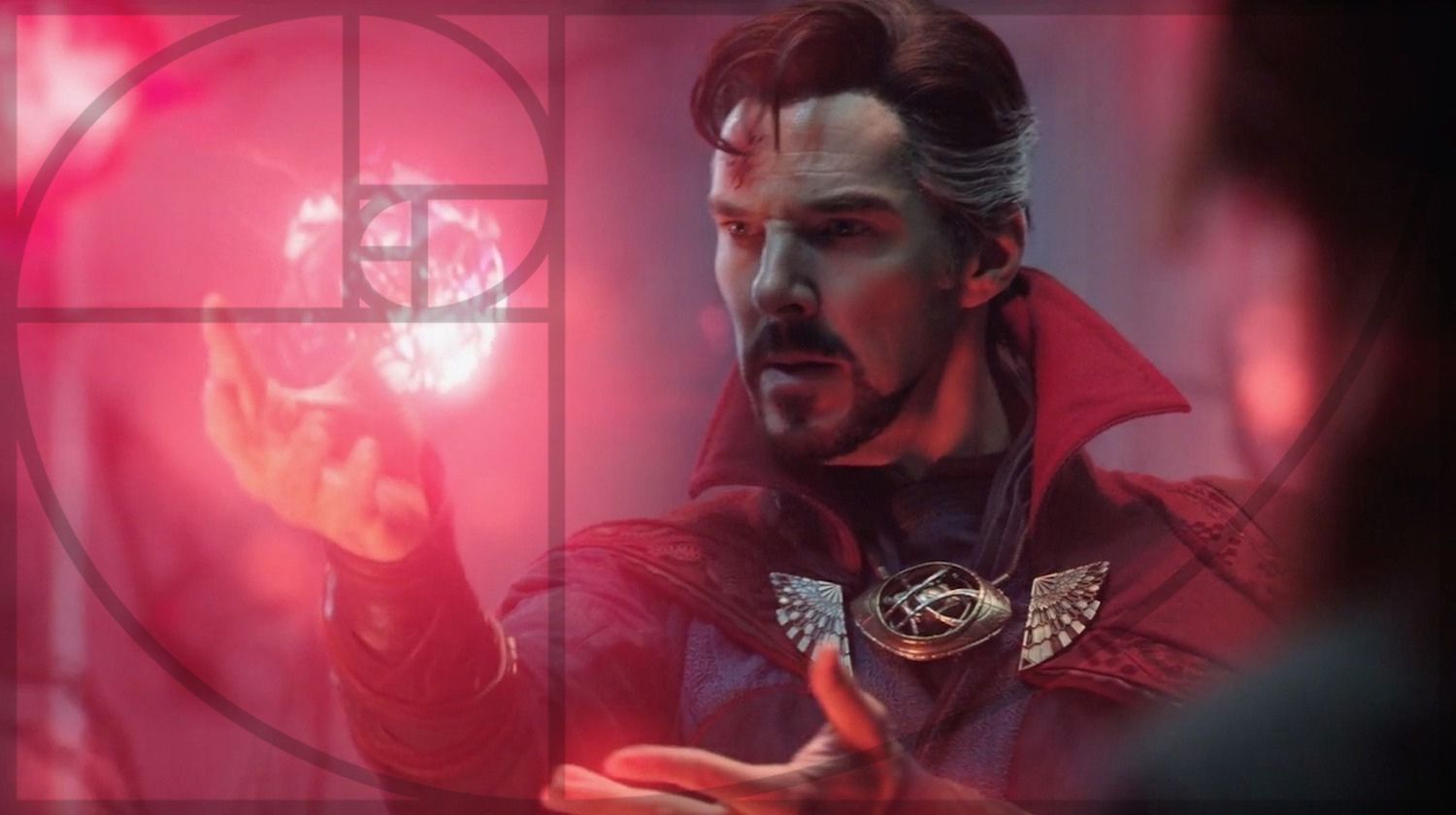
Composition and Framing are the two essential elements in visual story-telling. They refer to organizing and blocking the image by placing the subject, object and the background elements in the image making them pleasing and meaningful composition.
This provokes the audience attention and directs the narrative towards the contents that are more important, comparatively filling the image with other elements to make the narrative believable.

Composing the image with lines, shapes and color needs the right frame which executes them in the right perspective. These concepts require a keen eye for detail. The cinematographer must have the understanding of artistic principles as well as a creative approach to arrange the visual elements in a compelling manner.
To know in detail about composition and framing in cinematography, check this link:
Head room and Lead room
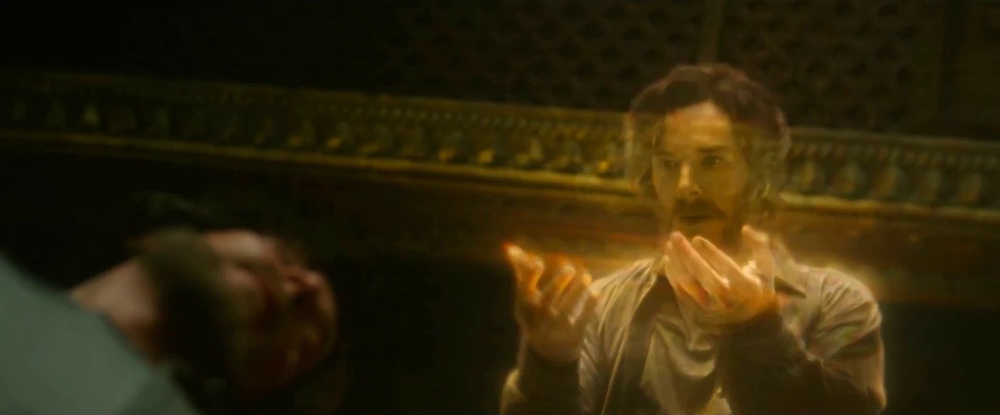
Head room and Lead room are two composition conventions used in filmmaking by positioning the subject within the frame. Head room refers to the space above a subject’s head within the frame, while lead room refers to the space in front of the direction the subject is moving towards.
Here’s an explanation of each:
Head room
Head room refers to the space between the top of a subject’s head which is the upper edge of the frame. It is essential to maintain an appropriate amount of head room to create a visually balanced composition.
Too much head room can make the subject appear small or isolated, while too little head room can make the frame feel claustrophobic or confined.
In general, it is recommended to provide a slight amount of head room above the subject’s head, allowing them to breathe within the frame. The exact amount of head room can vary depending on the shot, the subject, and the desired visual aesthetic.
For instance, in a close-up shot, you may want less head room to focus on the subject’s facial expressions, while in a wide shot, you may allow for more head room to show the subject within the larger environment.
Lead room
Lead room refers to the space in front of a moving subject within the frame. It is particularly relevant when filming subjects in motion, such as a walking person, a vehicle, or an animal. By leaving sufficient lead room, you provide visual space for the subject to move into, allowing the audience to anticipate their continued movement.
The amount of lead room needed depends on the direction of the subject’s movement within the frame. Generally, it is preferable to have more lead room on the side where the subject is moving towards rather than behind them. This helps maintain a sense of visual balance and gives the subject a clear path to move within the frame.
Both head room and lead room contribute to the overall composition and visual flow of a shot. They ensure that the subject is properly positioned within the frame, creating a visually pleasing and balanced image.
These techniques are used to guide the viewer’s attention, create a sense of space, and maintain visual clarity in relation to the subject’s movements.
While there are no rigid rules, certain conventions and techniques have evolved over time to guide filmmakers in effectively composing and framing their shots.
Here are the three common conventions:

1 Rule of Thirds
The rule of thirds is a guideline in visual composition that suggests dividing the frame into a 3×3 grid using two horizontal lines and two vertical lines. This creates nine equal-sized rectangular sections within the frame.
The main principle behind the rule of thirds is that important elements of the scene should be positioned along these lines or at their intersections. By relying on the rule of thirds, filmmakers can create visually balanced and pleasing compositions.
Here’s how the rule of thirds can be applied:
Subject Placement
When framing a shot, the main subject or point of interest is often positioned along one of the vertical lines or at the intersections of the lines. The intersections where the grid lines of the rule of thirds meet are particularly powerful positions to place the subject.
These points draw attention and create a focal point within the frame. The subject at these intersections can enhance the visual impact and compositional strength of the shot.
Also, placing the subject slightly off-center rather than in the center of the frame adds visual interest and allows the viewer’s eye to naturally explore the scene.
Horizon Line
In landscape shots, the rule of thirds can be used to determine the placement of the horizon line. It is generally advised to position the horizon along the upper or lower horizontal line, rather than in the middle of the frame.
- Upper Horizon Line is effective when the sky holds visual interest, such as during a stunning sunset, a timelapse of cloud formation, or a starry sky. It allows the sky to dominate the frame and can create a sense of openness and grandeur.
- Lower Horizon Line is useful when the foreground contains significant details, such as an interesting landscape, people, or objects of importance. It allows the foreground to be more prominent and draws the viewer’s attention to the immediate surroundings
Both the upper horizon and the lower horizon can create a more dynamic composition and highlight either the sky or the foreground.
It helps distribute visual weight in parallel throughout the frame and contributes to a more dynamic and engaging shot.

Leading Lines
The grid lines of the rule of thirds can be used to align or intersect with prominent leading lines within the scene. Leading lines, such as roads, fences, or architectural elements add depth and visual interest to the composition.
Leading lines can be natural or man-made. By placing these lines strategically within the frame, filmmakers create a visual pathway that leads the viewer’s eye to the main focal point of the shot.
Leading lines not only add depth and dimension to the composition but also help to establish a visual flow and guide the viewer’s gaze, enhancing the storytelling and emphasizing the significance of the subject within the scene.
Balance and Negative Space
The rule of thirds helps create a sense of balance in the frame by distributing elements across the grid. This includes considering the use of negative space, which is the empty or less cluttered areas of the frame.
The use of negative space can create a sense of simplicity, clarity, and visual impact. Negative space refers to the areas of the frame that are empty or have minimal visual content. It can also enhance the perception of balance by providing a contrast between occupied and empty areas.
Negative space provides a breathing room and allows the viewer’s eye to rest and focus on the main subject or elements of importance.
It is worth noting that the Rule of thirds is a guideline and breaking or bending it creatively can also result in innovative compositions. It depends on the specific storytelling objectives and visual aesthetic of the scene.

2 Center Framing
Center framing which is also called as Symmetry and Balance in composition which refers to distributing the elements evenly on either side of the frame or using a central point of focus to achieve visual symmetry.
This can be done by placing subjects or objects of similar size, color or importance on opposite sides of the frame. Symmetry involves creating a mirror-like reflection or an equal distribution of elements on either side of the frame.
This involves arrangement of visual elements within the frame to create a sense of equality.
Here is how the center framing is composed:
Visual Balance
Visual balance is achieved by distributing the elements within the frame in a way that creates a sense of equilibrium. The weight or visual importance of each element is considered to maintain a balanced composition.
Visual balance involves the visual weight, size, color and placement of each element to achieve a pleasing and balanced composition.
Visual balance prevents the composition from feeling heavy on one side. When elements are balanced, the audience can focus on the content of the scene without distraction by allowing the intended message or emotions to come across effectively.
For example, if there is a large object on one side of the frame, a smaller object of similar visual weight can be placed on the other side to create balance.
Symmetrical Composition
Symmetry involves dividing the frame into two equal halves, either horizontally or vertically. The elements on one side are mirrored or balanced by similar elements on the other side.
Symmetry can be achieved through architectural elements, patterns, or the placement of subjects. This creates a sense of order and stability in the composition. It can be visually pleasing and provide a sense of harmony.
Symmetrical compositions are often used to convey a sense of formality, balance or perfection, but they can also be altered creatively to add interest and evoke specific emotions within a scene.
Asymmetrical Balance
While balance often suggests equal distribution, Asymmetrical balance involves creating equilibrium through the careful arrangement of elements of different visual weights. Asymmetrical balance refers to a composition where the visual elements are distributed unevenly to create balance.
These concepts are somewhat contradictory because center framing usually suggests a symmetrical composition. However, if we consider asymmetrical balance within center framing, it could involve positioning other elements or negative space in a way that counterbalances the centered subject
This means that while the subject remains in the center, the surrounding elements are distributed asymmetrically to create a visually interesting and balanced composition.
The goal is to achieve a harmonious composition where elements of varying sizes, shapes and colors are positioned in a way that creates balance and visual interest.
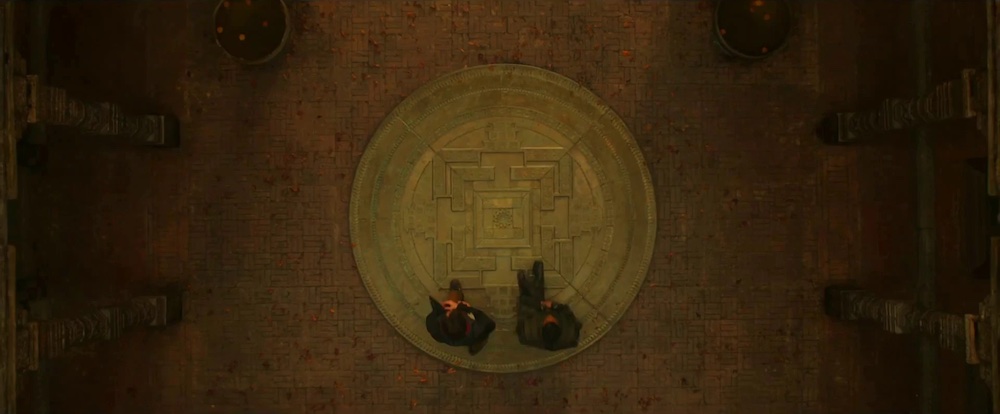
Radial Symmetry
Radial symmetry is achieved by positioning elements in a circular or spiral pattern around a central point. This type of composition can create a sense of dynamism and draw the viewer’s attention to the center of the frame.
This technique can be particularly effective in creating a visually striking image or highlighting the importance of the central subject in the narrative.
In radial symmetry, the elements radiate outwards from the center. This can be achieved by positioning objects, patterns, or lines in a circular or spiral arrangement. The circular pattern can symbolize harmony, balance and unity. While the spiral arrangement adds a sense of progression or growth.
Balance and symmetry can be used to create a sense of stability, order, and visual appeal in a composition. However, it’s important to note that perfect symmetry or balance can also be employed creatively to add visual tension or convey a specific mood or message.
Filmmakers often use center framing and balance as a foundation and then experiment with variations and deviations to achieve the desired artistic effect in their compositions. These composition create a sense of stability, order and gives an aesthetic appeal.
However, Center framing can also be intentionally disrupted to create tension or visual interest. Ultimately, the use of balance and symmetry depends on the desired mood, message and artistic intent of the filmmaker.
3 Golden Ratio
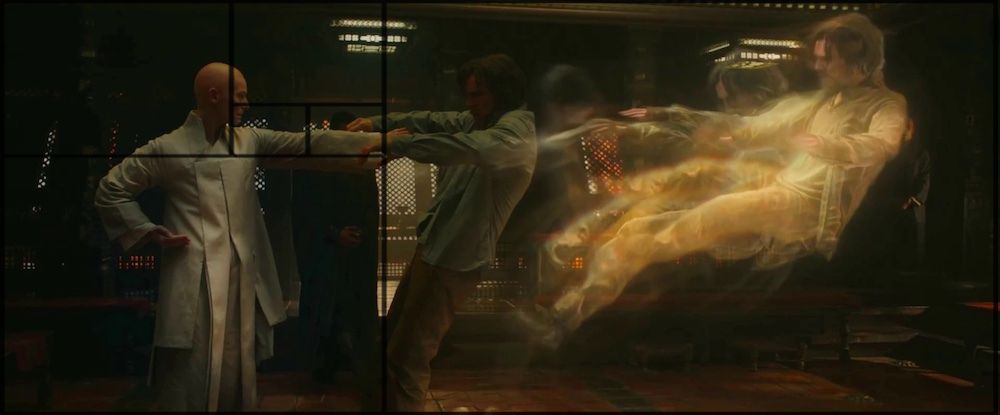
Similar to the rule of thirds, the Golden Ratio is a mathematical ratio that can be applied to various artistic disciplines, including film composition and framing. It suggests placing important elements along the ratio of 1:1.618, also known as phi, to create a visually pleasing and balanced composition.
In this explanation, we will delve into the golden ratio, its applications, and its different types and variations in film composition.
The golden ratio is a ratio found in nature and has been observed in various aspects of human aesthetics. It is believed to create a sense of balance, symmetry and beauty. In film composition and framing, applying the golden ratio can help create visually appealing and engaging frames.
There are several ways to incorporate the golden ratio into film composition:

Phi Grid
Similar to the rule of thirds, the phi grid divides the frame into a 3×3 grid with two horizontal lines and two vertical lines, but with proportions following the golden ratio. The focal points are located at the intersections of these lines, guiding the placement of important elements in the composition.
This technique helps create balanced and visually appealing compositions by aligning key elements with the grid’s intersections. By following the phi grid, filmmakers can achieve a sense proportion in their shots, drawing the viewer’s attention to the strategic placement of subjects, objects and points of interest within the composition.
Fibonacci Spiral
The Fibonacci spiral is a logarithmic spiral derived from the Fibonacci sequence, where each number is the sum of the two preceding ones (0, 1, 1, 2, 3, 5, 8, 13, etc.). By connecting arcs from one corner of each square to the opposite corner of the next, a spiral is formed.
This spiral can be imposed onto the frame and important elements can be placed along its path.
The spiral is created by connecting arcs based on these numbers. By aligning important elements along the spiral, a visually pleasing and balanced composition can be achieved.
Golden Triangle
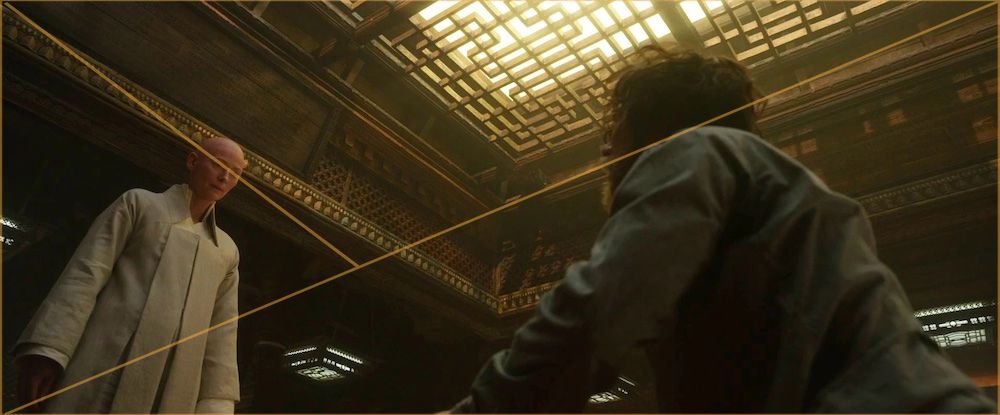
The golden triangle is formed by drawing diagonal lines across a rectangle based on the golden ratio. It involves dividing a frame into two diagonal lines that intersect at a right angle.
The resulting triangles can be used to guide the placement of key elements within the frame. The diagonal lines provide a sense of movement and lead the viewer’s eye towards the main subject, creating a dynamic and engaging visual experience.
Golden Rectangle
A golden rectangle is a rectangle with sides in the golden ratio. It is considered visually pleasing and can be used as a guide for framing the overall composition. Important elements can be placed within or around the rectangle to create balance and symmetry.
The longer side of the rectangle aligns with the horizontal or vertical axis, while important elements are positioned within or around the rectangle. Filmmakers can utilize this technique to enhance the visual impact and balance of their shots.
Aspect Ratio
The golden ratio can also be applied to aspect ratios. For example, the ratio of 16:10 approximates the golden ratio. Some filmmakers choose to use this aspect ratio to create visually appealing compositions that follow the golden ratio principles.
It’s important to note that while the golden ratio can be a useful tool in composition, it is not a strict rule. Filmmakers have the freedom to deviate from it and experiment with other composition techniques to suit the needs of their storytelling and visual style.
Its application can be seen through techniques such as the phi grid, Fibonacci spiral, golden triangle, golden rectangle, and aspect ratios approximating the golden ratio. By incorporating these principles, filmmakers can enhance the visual appeal and balance of their compositions.
In summary, the golden ratio is a mathematical concept that can be applied to film composition and framing to create visually pleasing and harmonious compositions.
However, it’s important to remember that artistic creativity and storytelling should ultimately guide the composition choices and the golden ratio is just one tool among many in a filmmaker’s arsenal. The golden ratio should be seen as a guideline rather than a strict formula.
Hope you find these three important composition and framing convention system worthy. If there’s anything more to it, let me know in the comments.
