

We say so-and-so movie “has style”.
We take the gravity of the word for granted because there’s always a reference point. It’s easy to point to a style (E.g., a Mohawk hairstyle) to recreate it (“Cut me a Mohawk!”).
What if you don’t have a reference point? What if you had to create a style from scratch?
Is there a way to find your own style? Yes!
My mission in this article is to help you find your own cinematic style. But, what is style in film?

We all know what style is, don’t we?
Is the style of a film its composition, color, film, camera, lens, costumes, set design, hair and makeup, filters, movement, editing, visual effects, audio, or music?
Or, is it the actors, how they laugh, how the camera moves, or in what zeitgeist the film is set, or what the theme is, or what the subtext is, or what the propaganda is?
In trying to get on with our lives, we sometimes forget to stop and think how all these elements come together to form a cinematic experience so unique that it lasts in our memories long after the film has been forgotten.
Which one of the above film elements contributes most to style?
This is why film style is a problematic word. Let’s get on the same page with that first.
What do the dictionaries say about style in film?
From Merriam-Webster:
a particular way in which something is done, created, or performed
a particular form or design of something
a way of behaving or of doing things
From Oxford Dictionary:
a particular procedure by which something is done; a manner or way
a distinctive appearance, typically determined by the principles according to which something is designed
[mass noun] elegance and sophistication
From Wikipedia:
In the visual arts, style is a “…distinctive manner which permits the grouping of works into related categories.” or “…any distinctive, and therefore recognizable, way in which an act is performed or an artifact made or ought to be performed and made.” It refers to the visual appearance of a work of art that relates it to other works by the same artist or one from the same period, training, location, “school”, art movement or archaeological culture: “The notion of style has long been the art historian’s principal mode of classifying works of art. By style he selects and shapes the history of art”.
Are there any common themes or words in all of the above definitions? Here are some words that stand out:
- Particular, distinctive, recognizable
- Way or manner in which it is done or created
- Way in which it is performed
- Appearance or design
- Grouping, relation to other works, classification
I can distill it down to three things:
- A distinctive vision
- A purposeful manner of achieving this vision, and
- A classification of the vision
Here’s what I mean by the three:
1 A distinctive vision
The visuals and audio combined must be so distinct that you can single it out from a “selection”.
A selection can be two things:
- Other shots in the same movie, or
- Shots from another movie.
A movie is made up of many shots, and they should relate to each other. The biggest difference between photography and movies is that movies make their point linearly.
Side note on linearity:
I don’t mean linear storytelling. Even non-linear storytelling is viewed linearly. The succession of images is like a flood that cannot be stopped. The movie must make sense in the present or it will lose its viewer.
Look at some images from Chinatown :
:
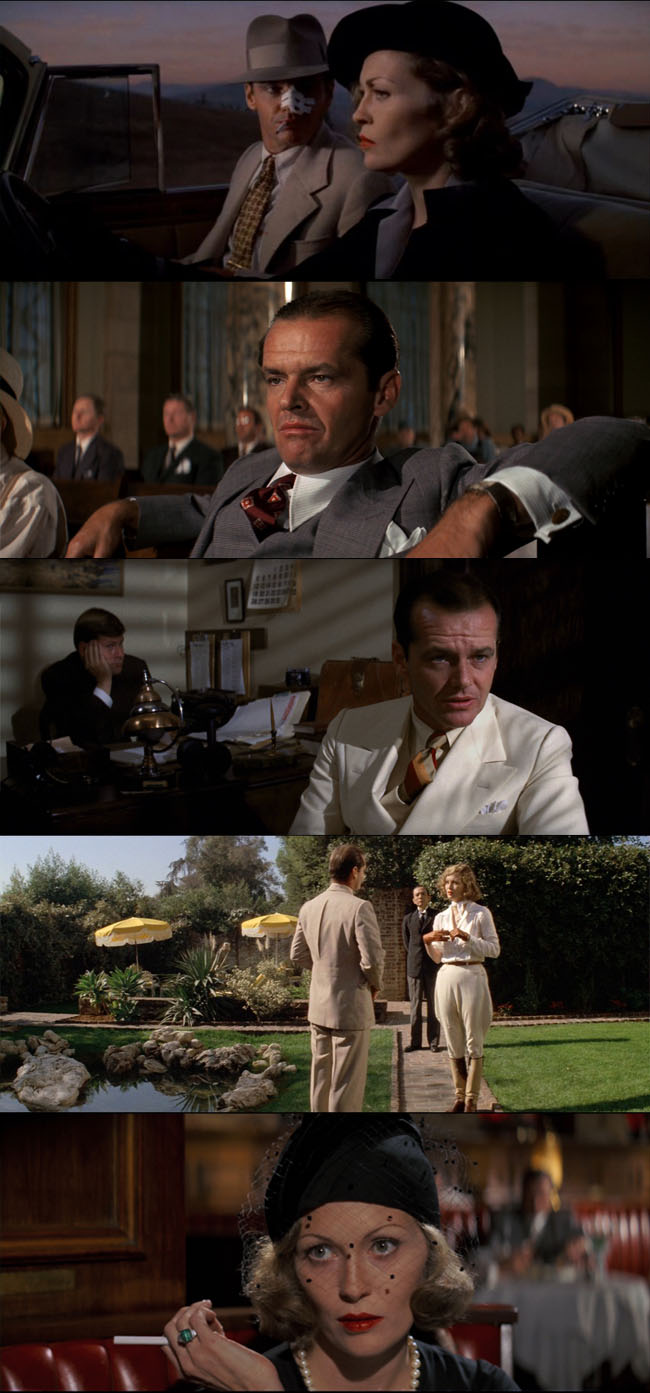
Do these frames look like they belong to the same movie? Having the same actor in different shots certainly helps, but it’s a whole lot more, isn’t it?
Does the following shot belong in Chinatown?

What’s unique about cinema is that you are forced to hold many elements constant over the course of a movie. E.g., Jack Nicholson dresses the same way, talks the same way, etc., so his character can serve the story.
The need for continuity, or linearity, is quite strong.
Most good movies have so many consistently repeated elements that you know it cannot be a fluke. The fact that Jack Nicholson dresses the same way isn’t happenstance. But, because he dresses the same way for most of 131 minutes, the style is that much more obvious. You can’t miss it.
If you aren’t aware of it while watching the movie, you would recognize it easily once it was pointed out. This is what makes a distinctive vision – there must be no doubt.
Just to clarify, a distinctive vision incorporates many elements, not just one thing (like how Jack dresses) – the greater the ‘combined’ continuity of all these elements, the stronger the style.
Ultimately, the purpose of a film is to transport us to a different time and place. The purpose of style is to do it uniquely.
2 A purposeful manner of achieving the vision
The ‘vision’ is what you see and hear. Would the manner in which you got there contribute in any way to your style?
I mean, should the fact that you used Camera A instead of Camera B contribute to your legacy?
As an example, take Stanley Kubrick’s choice of using only classical music for 2001: A Space Odyssey; or that Yasujiro Ozu only used a 50 mm lens; or that Hitchcock lost eighty pounds to fit inside the phone booth to shoot the scene in The Birds (just checking if you’re paying attention)!
Sometimes, the tools you use makes or breaks your style.
If the only lens that delivers your vision is a $50 contraption from the Cold-war era available on Ebay, then so be it.
Gregg Toland wanted maximum depth of field for Citizen Kane, and the only way he could do that was by stopping down the lens and flooding the set with light. That’s what he also did for The Little Foxes (1941).
In a nutshell, the manner – whether it be the tools or the techniques, in other words the art or the craft, matters.
3 A classification of the vision
If I asked you the time, and you happen to be wearing a wristwatch, you’ll look at it and read the time.
However, if you didn’t have a watch (or a smartphone), we’d be having all sorts of conversations, none of which will involve the actual time.
Discussing art is similar. If you are emotionally affected by a movie you wouldn’t care what a critic has to say about it. You like it, and that’s all that matters.
But for some people that isn’t enough. Studios, critics, academics, distributors, even members of the audience browsing through movie thumbnails on a streaming platform need a form of classification that will tell them what kind of movie it is.
Genre is one popular method of classification. Is it a murder mystery, or a rom-com, or found-footage horror, etc.?
That’s all well and good, until people start forcing movies into common genres, as if a movie cannot have its own identity.
Is your movie a romantic found-footage gore fest with some slapstick black humor? Guess what? People won’t take you seriously. They can’t, because they haven’t been trained to. This is the best you can get:
“Oh, it’s an art film.”
I’ll leave you to decide whether it’s a good thing or a bad thing to pigeonhole movies into categories. Just know that, as human beings, we need to classify stuff, or we can’t talk about it.
The sad part is, our classifications tend to dictate our choices, and even restrict us. Here’s an example.
From IMDb, highest rated movie in each category, 2013:
| Genre | Movie | My classification |
|---|---|---|
| Adventure | The Good, Bad and the Ugly | Spaghetti Western? |
| Horror | Psycho | Thriller? |
| Science Fiction | Star Wars | Where’s the science in Star Wars? Isn’t it a space fantasy? |
| Thriller | The Dark Knight | I guess, if you’re thrilled to have watched it, it makes it a thriller! |
You get the idea. Classification is a thankless exercise. How would you even begin to classify a movie like El Topo?

All the parts of style in film
I’m not an expert, and I don’t think anybody will come knocking on my door with an offer to pen a dictionary. Instead of offering you the definition, I’ll just make do with my working definition of style in cinema:
Style is a recurring collection of distinctively identifiable elements in a movie, brought about purposefully by a certain manner of production, to help tell a particular story by sustaining its linearity.
Sareesh
A filmmaker takes the trouble to put these pieces painstakingly together. Everyone else gets to call it style!
Don’t worry if this definition confuses you. I’ll give you an easier one soon. It doesn’t really matter what the technical definition is, because we are not linguists or philosophers (or are we?). It is pointless to dwell too much on definitions. We, as filmmakers, just have to go out there and film.
Now, as promised, let’s find a simpler definition of style.
What is style in cinema?
A quick recap. Style has three important parts:
- A distinctive vision – This is what helps people separate your work from the rest.
- Your manner of doing or creating your vision – This helps you reproduce your distinctive vision at will, and also helps you organize your thoughts into practical, actionable steps.
- Classification – This helps you to explain your art to people who haven’t the time, inclination, education or brain power to comprehend what you’re doing. Let’s not mince words, it’s marketing.
The definition of style I’ve been following ever since I got into filmmaking:
Making a movie has always been about telling a story…the way you tell that story should relate somehow to what that story is. Because that’s what style is: the way you tell a particular story.
…Critics talk about style as something apart from the movie because they need the style to be obvious. The reason they need it to be obvious is that they don’t really see. If the movie looks like a Ford or Coca-Cola commercial, they think that’s style. And it is. It’s trying to sell you something you don’t need and is stylistically geared to that goal. As soon as a “long lens” appears, that’s “style”.
…In one of the most thrilling moments of my professional life, he [Kurosawa] talked to me about the “beauty” of the camera work as well as of the picture [Prince of the City]. But he meant beauty in the sense of its organic connection to the material. And this is the connection that, for me, separates true stylists from decorators. The decorators are easy to recognize. That’s why critics love them so.
– Sidney Lumet, Making Movies
Others might need style as a crutch to explain, discuss, copy or judge your work, while you need it to get storytelling done. I’m concerned about style as a practical tool, not an article of discussion among non-filmmakers.
Most great film directors are embarrassed to talk about their style. While others go gaga over the fact that Quentin Tarantino writes his scripts with a set of three red and three black retro-styled Flair pens, he probably does it just to get his scripts written without a lot of fuss.
So, what is style in cinema?
For the filmmaker, style is what people will talk about after you’ve made your film. It doesn’t concern you during the act of storytelling.
When you’ve made a body of successful work others will try to find elements that span all your films and that becomes your style.
To the filmmaker:
Style is a storytelling plan followed strictly. You set the rules, and you stick to them.
– Sareesh
Others can call it style if they want. I just call it filmmaking.
How can one go about creating style?
Let’s say you want to actively pursue style by being consciously aware of it while making your movie. Which of the three aspects of style – the manner of creating your movie, the distinctiveness of its vision, or the classification of it – should you pay the most attention to and why?
The decision rests with you. I’ll just try to highlight some known instances of how the masters did it. As examples, I’m going to use a few directors I like:
- Akira Kurosawa
- Orson Welles
- Stanley Kubrick
- Alfred Hitchcock
It’s understood your style must be unique. This means there will also be a unique manner in which it must be carried out. If the manner is the same as what has come before your style won’t be unique.
Finding the right manner in which to achieve a distinctive vision
The film and cinematography essay videos I make tackle these things in excruciating detail. Let’s summarize a few here.
The style of Akira Kurosawa
Composition
Akira Kurosawa was a skilled painter, and many of his visuals seem to attempt to replicate the ‘flat’ composition of his paintings.
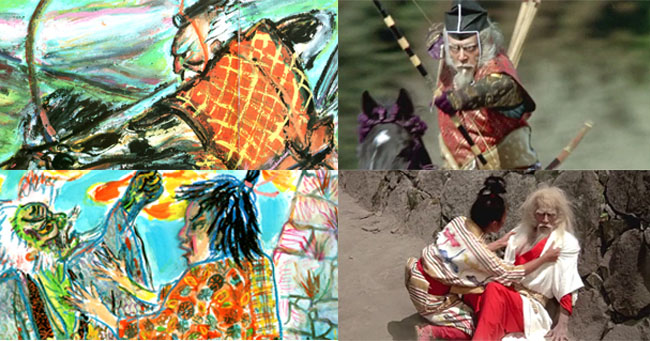
His black and white samurai films are probably the finest cinematic frames you’ll ever see.
You could pause any frame in Seven Samurai and it’s a well-composed photograph.
Lenses and Camera
A lot of people say Kurosawa only used long lenses, but that’s not exactly the truth. Here’s a comprehensive analysis of his lens choices.
Judging by his black and white masterpieces, he seems to have mainly used lenses from 25mm to 100mm.
His color work forced him to shift away from the Academy ratio, and this had repercussions on his entire visual style. Kurosawa also used multiple cameras ever since Seven Samurai, but never without purpose.
Film and Lighting
Long lenses with lots of depth of field presents a cinematography problem. You have to stop down the lens to f/5.6 or higher. This is fine if you’re shooting outdoors (Kurosawa shot a lot of exterior work).
But indoors, you’ll need tons of light to get it to work. It didn’t help that black and white film stock of the 50s got you only about 200 ASA. It would get very hot, like oven hot, on set.
Color
Kurosawa used color expressively. It had to mean something.
He loved Vincent van Gogh (which is why there is a van Gogh sequence in Dreams, played by Martin Scorsese!). You can sense that Kurosawa liked to create his world in images (he storyboarded everything himself) and then willed everything in it into existence.
Hair, Wardrobe and Production Design
The costume and production design work in his movies is also outstanding and painstakingly researched. Many of his films were adaptations of short stories, novels or plays (lots of Shakespeare). He drew a lot of knowledge and inspiration from reading western literature, watching Hollywood movies and from his own culture.
He wrote books, including an autobiography. Nothing in his movies is just ‘thrown’ in there. He even used the heat, dust, fog, rain, snow, wind, and fire, all with massive intent – never as an afterthought.
Editing
He edited in the Hollywood style, with invisible cuts. However, when he wanted it, he used jump cuts as well. His stories are almost always linear. He loved to move the camera and cut on action.
More cuts means you need more shots, because he hardly repeated shots. E.g., the average shot length in Seven Samurai is about 8 seconds. Compare that to Jurassic Park or Saving Private Ryan, which is about 7 seconds.
Music
He used music forcefully and romantically, drawing attention to itself. You could say he used it expressively, like everything else in his work.
The Kurosawa style
Just like Picasso, Kurosawa’s career had many distinct phases:
- Before Rashomon
 ,
, - The ‘samurai’ era,
- The anamorphic era, and
- The color era.
You can see the master’s hand in all four, yet there are enough stylistic differences to separate them.
I have been a huge fan of his work ever since I started filmmaking. I remember catching Dreams on television, accidentally, while switching channels. As soon it appeared on screen, I just knew it was Kurosawa. Everything about it – the composition, the mood, the cuts, everything – goes into making the signature Kurosawa style.

The style of Orson Welles
How do you know a great Orson Welles film? When he stars in it! Even if he’s not in the frame, he makes sure his presence is felt.
Composition
Orson Welles was a master in composition. Yet, you wouldn’t say that every frame of his is a photograph.
Why not? I think, because he didn’t deal with heroic or inspirational characters larger than life. He mostly dealt with flawed characters, whom society loves to hate.
Lenses and Camera
I think he was very much influenced by Gregg Toland, and stuck to wide angles most of his life.
Film and Lighting
Thousands of pages have been devoted on the subject of deep focus and how much light it needs. It was the sacrifice that needed to be made to get rich visual frames. However, deep focus has one major advantage, which Welles exploited. He is probably the undisputed master of the long take, like ones in Touch of Evil:
Hair, Wardrobe and Production design
Welles worked within the Hollywood system. Judging by his subject matter I’d say he had strong ideas about the world. He was good at making people appear as he wanted them to be, always strictly serving the story.
As far as sets were concerned, he built them to look realistic. It had to be functional, and come apart so a dolly could move through them.
Editing
Citizen Kane is studied so much for the many editing styles it contains, all in one film – and none of them looking out of place.
Music
I am of the impression that Welles’ use of music was purely functional.
The Welles style
Welles didn’t make too many great films, and those that are great are tough to single out as the work of one person.
For most of his filmmaking career he was under severe pressure to secure financing. The studios didn’t care about him. They were probably afraid if they gave him Ben Hur he’d make it all about Orson Welles.
The manner in which he got about achieving his style came as a direct consequence of the manner in which he lived his life. Did he choose long takes because he had to work fast and cheaply? Who knows? But, he made long takes, deep focus and wide angles his own. To put it mildly, he taught the world how it should be done.
The style of Stanley Kubrick
Stanley Kubrick was a perfectionist, and would painstakingly put the pieces of his film together (he collected boxes of photographs) before committing to it. He would also make his actors repeat takes until they gave him what he wanted, or died (just kidding).
But if there’s something you can’t take away from him, it’s his ability to pull off one iconic image in every movie:
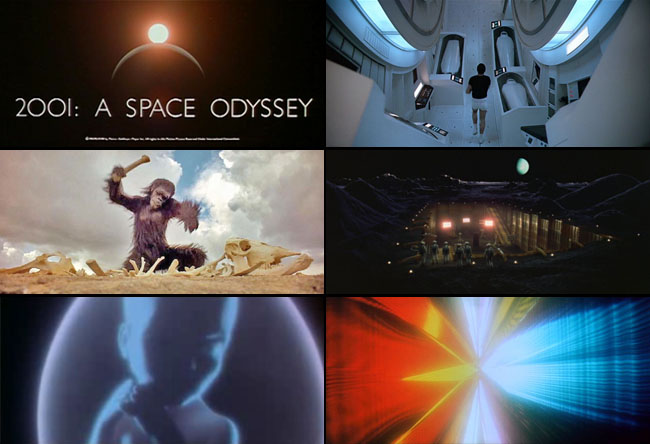
All of the above frames are from the same movie, 2001: A Space Odyssey. Kubrick never shied away from socially unacceptable subjects. Just watch A Clockwork Orange or Eyes Wide Shut or Full Metal Jacket.
Composition
He had his unique style of composing his subjects bang in the center of the frame, both horizontally and vertically.
Lenses and Camera
He loved wide angles. He loved to have lenses made specifically for his movies. He always looked for new rigs to get his shot. He selected his lenses and cameras like how a doctor asks for a scalpel.
On the whole, though, he preferred wide angles, which worked really well with his compositional sense. It also allowed him to use zoom lenses, and he zoomed like they were going to take his zoom lens away from him at any moment!
He used the zoom so purposefully, that it made sense. I can’t imagine Barry Lyndon without the zooms. On the other hand, I can’t imagine A Clockwork Orange without the tracking shots.
He took all the stuff everyone tells you never to do, and made it work.
Film and Lighting
He used what he could. A lot of people think Barry Lyndon has no artificial lighting, but many shots are lit. Many think he pushed the candle-scenes by one stop, but he pushed the entire film by one stop.
In fact, his fixation on really wide angles probably meant the cinematographer had to just light the set and sit back and watch. I wonder what would have happened if they put Gordon Willis and Kubrick into the same room?
Color
This is interesting, because Kubrick started filmmaking in the black and white era, and like all those in the same boat, had trouble finding his own ‘color’ voice.
He chose to subjugate it as a functional tool, because he was a slave to his own box of photographs. They had to match!
Hair, Wardrobe and Production design
Kubrick was involved in every detail of his set, and probably took great delight in production design. His sets had to follow his compositions and angles, so they were an integral part of his vision.
On the whole, I’m not sure he really cared that much about wardrobe or hair and makeup.
Editing
2001: A Space Odyssey has one of the greatest cuts in filmmaking history, when the bone turns into a space ship. He lets his frames linger a bit longer than most would dare.
Music
Kubrick always chose his music first, and leave nothing to chance. One oddity has to be the orgy sequence in Eyes Wide Shut, which used a chant played back in reverse.
Whatever works!
The Kubrick style
Clinical, that’s what his style is.
Even when he studied human beings and their base natures, he was always at a distance, observing. His framing put his actors bang in the center, with nowhere to escape. Whatever subject he tackled, he made sure he laid it bare.
They are there to be studied, and possibly judged.
The style of Alfred Hitchcock
One of the most beautiful things about Hitchcock was color:

Everything else was suspenseful, and he was the master of getting our rears to the edges of our seats. He likes to give the audience information so they become invested in the story.
Composition
Hitchcock composed in the Hollywood style, where the cuts are hidden and the image does not draw attention to itself. In fact, if someone didn’t know Hitchcock at all, they would be hard-pressed to distinguish his work from other movies during the same period.
Lenses and Camera
He stuck to classical medium lenses, notably the 50mm. But he also used wide angles when he was allowed the set and space.
Film and Lighting
His lighting is classic Hollywood. In fact, if there’s one thing I don’t like about Hitchcock, it’s the fact that he played safe with his lighting. Don’t get me wrong, the lighting works brilliantly to set the mood. But, it hasn’t aged well. Today, the scenes look over lit and devoid of any signature.
Color
His colors are always with some intent, as in Vertigo (Vittorio Storaro would have loved that). You know he was aware of his colors because he took it all away for Psycho.
He predominantly used Eastmancolor film during the time.
Hair, Wardrobe and Production Design
He worked with studios, and had his sets built. He loved to create one-location scenarios (Rear Window, Psycho to a certain extent, Rope, Dial M for Murder, ad infinitum), but they only reflected what everyone else was doing at the same time.
One gets the distinct impression that you could replace all the sets and costumes, and still get the same story.
Editing
This is where Hitchcock showed his mastery. He was brilliant at placing imagery where it would create the greatest suspense. He gave the audience so much information that they cringed. They didn’t want to know too much about the person who they know will be murdered any instant.
He taught the world how to create suspense – pure, unadulterated suspense. He called it ‘pure cinema’.
Music
The only time I have seen (or heard) music stand out in a Hitchcock movie is with Psycho. The music in Psycho is so in-your-face, and it works big time. Can’t imagine Psycho with another score.
However, my favorite musical piece is in The Birds, where the children sing inside the school, unaware of what is gathering outside. That scene also shows Hitchcock at his subliminal best at editing.
The Alfred Hitchock style
Did Hitchcock make the same movie over and over again in his prolific career? If yes, nobody noticed. That’s saying something.
He had the tough task of entertaining us, sometimes in gruesome ways, and almost always involving macabre.
I bet he loved it!
A small breather before we finish:

Now let’s try to understand the importance of classification, probably the only aspect of style that most filmmakers hate.
Why do we need to classify anything as style?
Think movie seats.

You have fixed rows (usually alphabetical) and seats (numerical). Without a system of classification you wouldn’t be able to find your seat easily. Here are some others:
- A vendor can deliver your meal to your seat faster.
- The movie chain can study data on which rows or seats are the most popular.
- Nobody fights over a seat.
Humans name things (including themselves) for easier identification. It’s how we use language, how we think and how we organize our lives.
Like folders on hard drives, we need ‘higher and higher levels’ of classification. Like ‘boys’ and ‘girls’, or ‘sneakers’, ‘loafers’, and ‘boots’, etc.
The advantages of good classification:
- People can find things easily.
- You can remember things and gain insights about them.
- People speak the same language. Once they learn the classification through years of use, they can take in more complex data. Like acquiring a taste.
How movies are classified, and why
Movies can be classified in many ways:
- Language
- Duration
- Budget
- Revenue
- Censor rating
- Leading stars
- Director
- Genre
- Story
- Plot elements
- And many others
Filmmaking isn’t a cheap form of art, so you have to have an audience in mind, even if that audience is just you.
It might be worth the trouble to understand what makes you, you. Such soul searching is part of the filmmaking process anyway. So you might want to have that information at hand. Or maybe you just want it to play out subconsciously?
Are there any practical benefits as to why you should take the trouble to classify your own styles and movies?
Sure. Let’s look at a few.
How language affects film style
Language is an integral part of moviemaking, and serious writers don’t use it frivolously. People don’t speak perfectly in real life, so when you craft your dialogues you’ll ensure the language can be understood in a certain manner, without any element of doubt.
But what if your movie is to be seen by those who don’t speak your language, or by those for whom your language isn’t their native tongue?
If you do not think about how your work is going to be comprehended by your audience, you will be left at the mercy of those who do (or at least pretend to).
A good example is Japanese anime. If you’re not a Japanese speaker you’ll either watch the original subtitled in your language, or watch a dubbed version. The difference is usually night and day.
Does the duration and budget of your film influence its style?
Hollywood is notorious for reporting inflated budgets, and every year it goes higher. The average person (even the average rich person) can no longer comprehend its magnitude. E.g., if I say Alpha Centauri is four light years away, does that mean anything to you?
The budget definitely impacts the duration of your movie. The more days you have to shoot, the larger your budget needs to be, even if it’s a zero budget movie.
The budget compels you to make revisions in the duration of your film, usually by reducing it. Sometimes radical changes must be made in the writing, shooting or editing. If you’re in the writing stage you can rewrite sections. If it’s in the editing stage you’ll throw away whole scenes. If it’s in the production phase the last scenes to be shot are usually the ones thrown out.
Money talks. That should come as no surprise.
Your style is always in part a slave to your budget. If you don’t get the money part right in filmmaking, you rarely get the result you intended.
Does revenue and popularity have anything to do with style?
We all search for the most popular films. It’s not uncommon to find lists like:
- The greatest movies of all time.
- The top 100 action movies of the decade.
- YouTube filters by view count.
- The top Hollywood grossers ever.
How does this impact style? It would, if your aim is to be on one of these lists.
Most filmmakers aspire to make great movies and win awards. How does that impact your choice of subject, or the way you tell it?
If your aim is get a million views on YouTube, then you will create content that caters to that goal.
How was the style of Avatar shaped by the enormous pressure on James Cameron to earn a billion dollars? Only he can answer that, but you get the idea.
Does the censor rating affect style in film?
If you’re tackling a subject that is better left for adults, would you want children seeing it? Even if you’re selling to an adult audience, you wouldn’t want to thrust something on them that they are not prepared to see.
Not all adults are mature. Not all adults are understanding. And none are completely rational.
There is one kind of movie that none of us are prepared to see, though. And that’s a boring movie!
Do leading stars and popular directors impact the perception of style?
You bet.
People watch movies for its leading stars, otherwise upper tier low-budget Hollywood movies ($20-30 million) wouldn’t get made. If you thumbnails or posters in front of me, and I could pick any one for free, I would pick the one which shows a face I like (assuming all other things are equal).
For many people, the faces are all that matter.
Popular actors don’t behave like you and me (unless you’re popular).
They lead busy lives, have many commitments, and are under pressure to hold their positions. If you’re a popular director you’ll have a first hand experience of the market, and your choices will be governed by it.
Some directors play safe always, like Steven Spielberg, for example. Others, like Alejandro Jodorowsky or Welles or Chaplin, never let that worry them too much.
Stars are another kind of fish. Not only do they have all the quirks of actors per se, they are established ‘brands’ that need to be maintained even if they are playing characters in toons.
Then, you are saddled with the job of rewriting your film to suit their idiosyncrasies. Does that bother you?
Only you can know.
Does the genre impact the perception of style?
Even your crew will want to know what genre your film is.
You can’t blame them. This is how we are educated and trained about movies. This is how we ahave always talked about them.
Even Shakespeare wrote “comedies” and “tragedies”, and The Illiad and the Mahabharatha are “epics”. Can anybody make you change the way you use words? Then don’t try to insult your audience’s intelligence by assuming you can change theirs.
The major problem with genre is that your movie is then expected to follow certain ‘inviolable’ paradigms. You might hate these, and want to take your movie into another direction, but that would change the genre! E.g., if your genre is action, then you must have:
- Fast-paced, quickly edited action scenes (duh!).
- Periods of lull so the action sequences seem even more impactful.
- Characters who can physically pull off the action. If you have an unlimited budget, you can replace your leads with CGI or stand-ins, but then you must change your shot to hide their faces!
- Fast-paced music – unless you want to hear Fur Elise during the climactic sequence in the Avengers.
- Louder sound effects to go with the action.
- Characters screaming so their voices are heard over the sound effects and music.
Take any genre, you will find such rules. Some rules are silly, until you begin to see how they might impact your style. You can’t have everything.
Do Story and plot elements contribute to style?
What’s it about? That’s as fundamental as it gets, isn’t it?
Writers are encouraged to write log-lines so their entire work can be judged in less than thirty seconds.
Plot elements affect the plot and enters our lexicon through popular discourse. One such plot device is the ‘twist at the end‘ – a la The Sixth Sense. M. Night got so caught up in adding a twist in every movie, his entire career got twisted.
Do you think the twists at the end of The Sixth Sense, Unbreakable and The Village didn’t have an effect on how his characters and cameras behaved?
Another famous plot element is the song, where characters, who were behaving perfectly natural until then, suddenly start performing and singing, but not in their voices. Happens a lot in Bollywood.
One more plot element: the gorgeous person coming out of the water in their scanty swimming gear. If every Bond movie has to have one, then how does that help a director stamp his or her personal vision on the movie?
This is one reason why many major Hollywood movies all look the same. Anybody could have directed them.
A lot of people think that’s Hollywood’s fault. Is it? Really?
They just do what people want:
Another word for the overly used plot element is “cliche”.
First we create rules for genres and stories, and when everyone follows these rules, they become cliches!
It’s called being human.
Here are some other styles that are imposed on the filmmaker due to ‘force majeure’:
- Orange and teal color grading
- Long, drawn out but exciting title sequences to hide a boring opening scene
- The intermission
- Inside jokes and homages to other movies or scenes that call attention to themselves
- Product placements
- Love-making scenes
- A climactic chase
- Forced humor
- The appropriate percentage of racial ‘in’-discrimination
- Older males, younger females (or at least younger looking females)
- Females must always be pretty, even if their characters are ugly (Ugly Betty, Shrek)
- Shaky-cam, super slow-mo
- Lens flare
Ad nauseam. I think you get the idea.
Every single choice you make, no matter what kind of film you’re doing, impacts your style. If you’re looking to find your unique vision, then be prepared to fight your battles on many fronts.
Can film styles be copied?
This is an interesting topic. Many famous movies are often remade. Some movies that have been made three times are The Jazz Singer, King Kong, 12 Angry Men, Stagecoach, etc.
Two movies that are exact shot-by-shot copies (as much as it will ever be) are Psycho (1998, original 1960) and The Barretts of Wimpole Street (1957, original 1934).
The latter is of particular interest because it was remade by the same director, Sidney Franklin!
Regarding Psycho, this is from Wikipedia:
A number of critics and writers viewed Van Sant’s version more as an actual experiment in shot-for-shot remakes. Many people refer to this film as a duplicate of the 1960 film rather than a remake. Film critic Roger Ebert, who gave the film one-and-a-half stars, wrote that the film “demonstrates that a shot-by-shot remake is pointless; genius apparently resides between or beneath the shots, or in chemistry that cannot be timed or counted.” Screenwriter Joseph Stefano, who wrote the original script, thought that although she spoke the same lines, Anne Heche portrays Marion Crane as an entirely different character. Even Van Sant admitted that it was an experiment that proved that no one can really copy a film exactly the same way as the original.
Anyway, it doesn’t matter which one’s your favorite. The question is: Can a frame-by-frame remake replace it?
The very nature of filmmaking guarantees copies can’t reproduce the originals. It’s impossible.
Actors become old or die, directors forget how to direct, locations change, film stock or camera sensors change, fashion changes, language changes, the audience changes, and so on.
Here’s a thought: Maybe they should remake bad movies that had potential, instead of screwing up perfectly good ones.
How to create your own unique film style
Your style, no matter how you define it, is not only inextricably entwined with the manner you produce it, but also with the audience’s expectations and classifications of your movie.
This means, even if you envision the “greatest movie ever made” in your head, by the time it arrives on screen, it will have changed. There’s nothing you can do about it.
All you can do is decide which aspects of it are worth focusing on and fighting over.
If you manage to pull off your unique style, by being master of the medium of cinema, and by being a ‘non-confusing’ storyteller (in other words deliver on your marketing promise) to your audiences, then you have just struck a pot of gold.
Look at some of the modern names whose styles are unmistakable:
- Quentin Tarantino
- Ridley Scott
- Terrence Malick
- Steven Spielberg
- Christopher Nolan
You can’t copy them, even if you tried. When you have delivered your own unique style, the world will stop and take notice.
A new classification will be created, one in your name.
Then it will be for the ages to protect it.
That’s style.
