
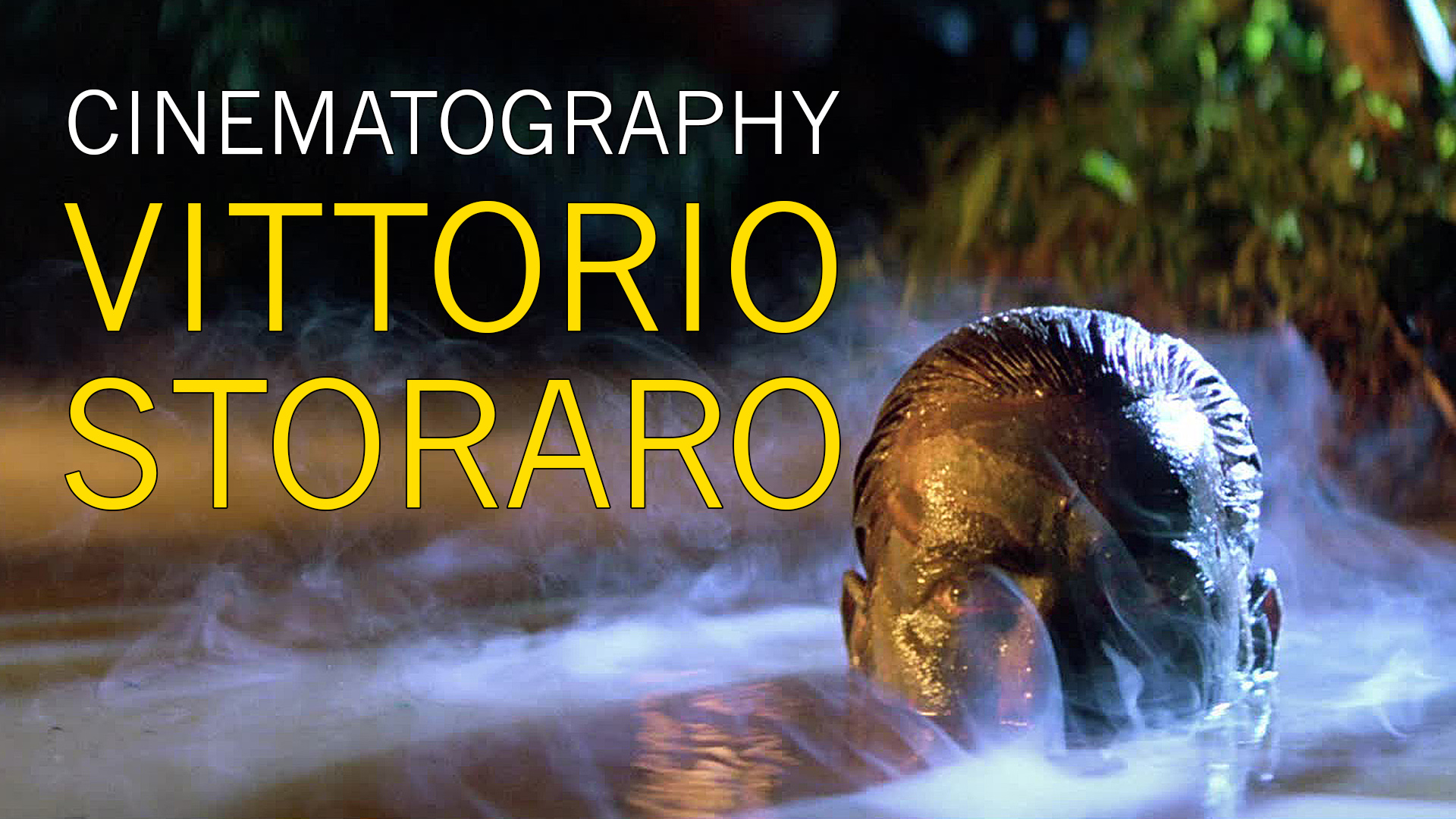
Vittorio Storaro is unique in one simple way: he intellectualizes and rationalizes his usage of light and color, and in this respect he probably stands shoulders above every other cinematographer.I go through some of his cinematography lighting and camera techniques to help you understand his unique style.
Just to be clear: Vittorio Storaro changed his style to suit the movies he shot. The goal of this video and article is to drum up enthusiasm and a yearning to learn more.
Warning: I do not claim this knowledge is 100% accurate. Just think of it as an endorsement of his work. If you want accuracy, look someplace else.

His lighting philosophy
He started with the key light. This gave the scene mood and texture. He lit for the scene rather than the actor.
The actors were free to move in and out of his light, so to speak. It was highly controlled, and it resulted in interesting effects.
As far as fill light is concerned, he rarely used it for interiors, though I’m sure he bounced back light for fill. He did use tungsten/halogen fixtures for exteriors to give his scene a golden-hour look.
Overall, he preferred warm shades.
Lighting faces
He had two signature styles:
- The short-lighting pattern, which gave him the freedom to light the scene over the face.
- The side light, which is a variation of the above.
He used for diffused and hard sources depending on the point he wanted to make – which only he knew.
Lenses and movement
He used both primes and zooms, all Cooke lenses as far as I know, rehoused by Technovision in Italy. I don’t think they are active any more, but I could be wrong.
He preferred standard to telephoto lengths, and assumed the director will take care of the focal length – as is the tradition among auteurs.
Color
This is where he stands apart. He has his own interpretation of colors, which you can find in the 1992 documentary called Writing with Light. He later also wrote a book in the same name. I won’t go into detail about it here, because it is not the exact theory that matters, but the fact that colors and light can be interpreted this way.
You can also learn more about him through countless interviews and articles, and his personal website.
I hope you’ve found this article useful. If I’ve stoked your interest in Vittorio Storaro’s work, please watch the movies he shot. They are mandatory viewing for students of cinema.
