

In this article we’ll compare these four cinema cameras all designed to appeal to the low budget filmmaker.
- Sony FX6 (Amazon, B&H)
- Canon EOS C80 (Amazon, B&H)
- Blackmagic Design PYXIS 12K
- Red Komodo-X
Here are the prices of the body only, at the time of writing:
| Camera | Price of Body |
|---|---|
| Sony FX6 | $5,998 |
| Canon EOS C80 | $5,499 |
| Blackmagic Design PYXIS 12K | $5,495 |
| Red Komodo-X | $6,995 |
They are similarly priced, with the Red Komodo-X coming in a bit higher (body only) It has a global shutter, and this sets it apart from the others. If you absolutely need a global shutter, then the decision is already made!
A quick note about after sales and service
It’s funny to start a comparison article with sales and support, but it’s critical on any budget.
It’s always important to investigate and feel out the after-sales and service in your country or area prior to committing to any camera. No point in buying a camera and then having to pull your hair out when you realize you have to ship your camera overseas for repairs.
Also, don’t underestimate the importance of parts and accessories, and how long things will take to buy or repair. I’m assuming these cameras are on equal terms in your region (it’s not in mine!).
There will be only one winner! Let’s get to it.


Comparison of sensors and video features
Let’s divide this section into sensor performance, frame rates, codecs, lenses and autofocus performance.
Sensor performance
Here’s how the camera sensors compare:
| Camera | Maximum Resolution | Sensor Size |
| Sony FX6 | 4096 x 2160 | 35.7 x 18.8 mm |
| Canon EOS C80 | 6008 x 3170 | 36.0 x 19.0 mm |
| Blackmagic Design PYXIS 12K | 12,288 x 8040 | 35.64 x 23.32 mm |
| Red Komodo-X | 6144 x 3240 | 27.03 x 14.26 mm |
Except for the Komodo-X, all cameras have full frame sensors. If you absolutely need a full frame sensor, you can strike off one camera from the list!
The size of the sensor is not an indicator of quality, only aesthetics. To me personally, it wouldn’t matter for personal films, but if a client wants it, or you’re a working cinematographer, having a full frame camera is a lot more useful than one with a Super 35 sensor.
Here are all the options you get with the different cameras:
| Camera | 6K Full Frame | 4K Full Frame | 4K Super 35 | 4K Anamorphic |
|---|---|---|---|---|
| Sony FX6 | No | Yes | No | No |
| Canon EOS C80 | Yes | Yes | Yes | Yes |
| Blackmagic Design PYXIS 12K | Yes | Yes | Yes | Yes |
| Red Komodo-X | No | No | Yes | No |
Let’s dig deeper:
| Camera | Dynamic Range* | Built-in ND | Shutter |
|---|---|---|---|
| Sony FX6# | 15+ stops | Yes, 2-7 stops | Rolling |
| Canon EOS C80 | 16 stops | Yes, 2, 4 and 6 (8 & 10)^ stops | Rolling |
| Blackmagic Design PYXIS 12K | 16 stops | No | Rolling |
| Red Komodo-X | 16.5+ stops | No | Global |
*You can’t compare these dynamic range numbers directly because almost all of them fudge the numbers.
^8 and 10 through using two NDs at the same time (6+2) and (6+4). Canon calls this extended mode.
Is it important to have a built-in ND filter? Yes, it saves money and time – and it’s one thing you don’t have to worry about.
What about sensitivity?
| Camera | ISO Range | Base ISO |
|---|---|---|
| Sony FX6 | 800 to 409,600 | 800 / 12800 |
| Canon EOS C80 | 100 to 102,400 | 800 / 3200 / 12800 |
| Blackmagic Design PYXIS 12K | Not published | 800 |
| Red Komodo-X | 250 to 12,800 | 800 |
The Sony FX6 (Amazon, B&H) is definitely the best camera for low light, but the Canon Canon EOS C80 (Amazon, B&H) is no slouch either.

Frame rates
Here are the most important frame rates:
| Camera | Max fps at Max Resolution | Max fps at 4K | Max fps at 1080p |
|---|---|---|---|
| Sony FX6 | 3840 x 2160 @ 120 fps* | 3840 x 2160 @ 120 fps* | 1920 x 1080 @ 120 fps** |
| Canon EOS C80 | 6000 x 3164 @ 30 fps | 4368 x 2304 @ 120 fps | 2048 x 1080 @ 180 fps^ |
| Blackmagic Design PYXIS 12K | 12K (3:2 open gate) @ 40 fps up to 12K (2.4:1) @ 60 fps | 8K/4K (3:2 open gate) @ 72 fps up to 8K/4K (2.4:1) @ 112 fps | N/A |
| Red Komodo-X | 6144 x 3240 @ 80 fps 5120 x 2700 @ 96 fps | 4096 x 2160 @ 120 fps | 2048 x 1080 @ 240 fps |
**The FX6 can do higher frame rates but in less than 1080p resolution.
^180 fps is in 2K/Super 16mm mode.
All of them can do just about 120 fps in 4K DCI or UHD (90 fps for the PYXIS in 12K, 65 fps in 9K). However, on the whole, the Red Komodo-X seems to be the most versatile camera in this list for high frame rate recording.
Codecs
| Camera | Internal RAW | External RAW* | Bit depth for RAW | Other Codecs |
|---|---|---|---|---|
| Sony FX6 | No RAW | ProRes RAW via HDMI | 16-bit^ | XAVC-I |
| Canon EOS C80 | Cinema RAW Light | No | 12-bit | XF-AVC, H.265/H.264 |
| Blackmagic Design PYXIS 12K | BRAW | BRAW | 12-bit | None, H.264 only in proxy mode |
| Red Komodo-X | Redcode RAW | No | 12-bit | Prores HQ (up to 4KProres HQ (up to 4444 XQ) |
^Disregard the 16-bit bit depth on the Sony FX6, it’s probably just 12-bit rewrapped. It’s unlikely you’ll get true 16-bit for this price.
The Red Komodo-X wins this one because of the popularity of Redcode RAW and the options that it gives for ProRes. The H.265 variants are not easy to edit with – not even close compared to ProRes.
What you get externally:
| Camera | Connection | Best resolution and fps | Audio Input |
|---|---|---|---|
| Sony FX6 | 12G SDI x1, HDMI x1 | 4264 x 2408 @ 60fps | UHD @120 fps^ | 2x XLR |
| Canon EOS C80 | 12G SDI x1, HDMI x1 | 4096 x 2160p @ 60fps | 2x Mini XLR |
| Blackmagic Design PYXIS 12K | 12G-SDI x1 | 4096 x 2160p @ 60fps | 1x Mini XLR |
| Red Komodo-X | 12G SDI x1 | 4096 x 2160p @ 60fps | 5-Pin port |
One of the important distinctions of a cinema camera is the availability of additional SDI/HDMI ports for monitoring and recording.
The Sony FX6 (Amazon, B&H) clearly wins this round with two XLR inputs and both SDI and HDMI ports. The Canon EOS C80 (Amazon, B&H) is a close second but hate mini-XLR inputs.

Lens mounts
Being cinema cameras, what mounts are on offer?
| Camera | Mounts | Price for PL mount |
| Sony FX6 | Sony E mount | $467* |
| Canon EOS C80 | Canon RF | $424* |
| Blackmagic Design PYXIS 12K | Leica L, Canon EF, Arri PL | 0$ |
| Red Komodo-X | Canon RF, Nikon Z | $424* |
Every camera offers a small flange focal distance option so you can adapt virtually any lens with a lens adapter.
If your goal is to end up with PL glass you need to factor in the additional cost for a lens adapter. If you do opt of the Leica L-mount or EF mount option for the PYXIS 12K, you need to factor in the cost of an L to PL adapter. You can’t swap lens mount plates on the fly.
Overall, the Blackmagic Design PYXIS 12K gives you the most options, except if you need autofocus.
Autofocus performance
Here are the details:
| Camera | Continuous Autofocus |
| Sony FX6 | Phase Detection AF with Eye Tracking |
| Canon EOS C80 | Dual Pixel CMOS AF |
| Blackmagic Design PYXIS 12K | Bare minimum |
| Red Komodo-X | Phase Detect and Contrast |
The Dual Pixel CMOS autofocus by Canon wins hands down giving this round to the Canon EOS C80 (Amazon, B&H). The Sony FX6 (Amazon, B&H) is no slouch either.
Monitoring and ergonomics
Now let’s talk about other things.
Weight and size
Let’s look at the weight and size:
| Camera | Volume (size) | Weight (Body Only) |
| Sony FX6 | 123 cubic inches | 890g |
| Canon EOS C80 | 147 cubic inches | 1.19 kg |
| Blackmagic Design PYXIS 12K | 116 cubic inches | 1.59 kg |
| Red Komodo-X | 78 cubic inches | 1.19 kg |
The Sony FX6 (Amazon, B&H) impresses with the number of features that it has packed in a relatively light body. The PYXIS 12K, being a smaller camera, is the heaviest!
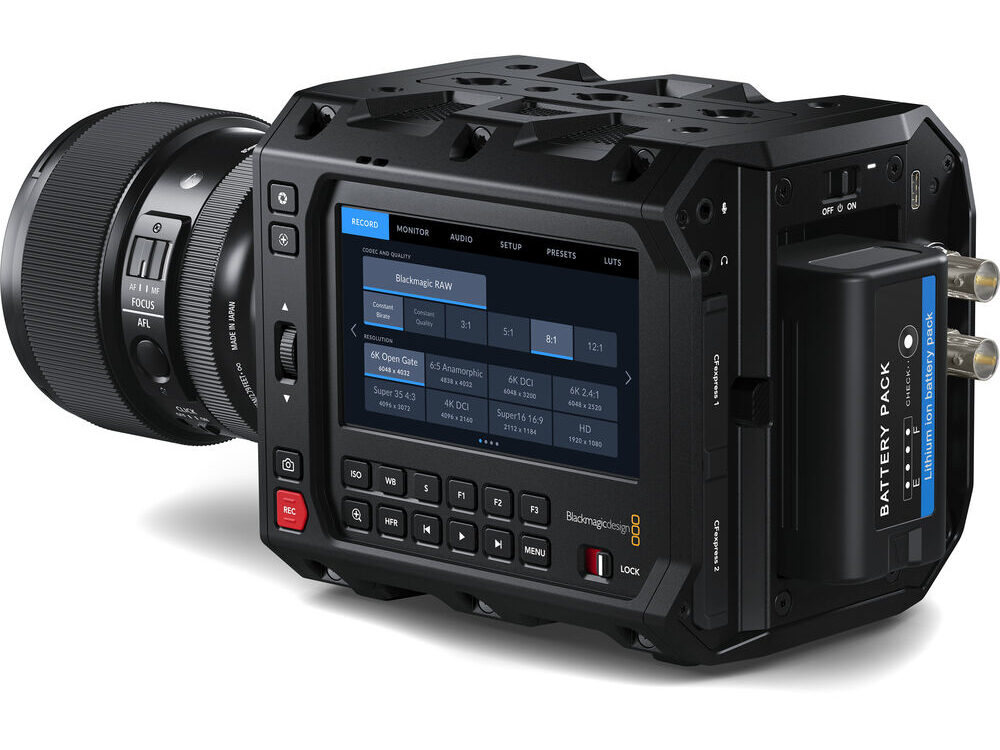
What about the LCD monitor? Some of the cameras have a monitor you can watch your footage on, and this is handy in a pinch. For serious monitoring, though, you need an external monitor that’s at least 5″.
All the cameras can be operated without a dedicated monitor or viewfinder.
| Camera | Monitor |
| Sony FX6 | 3.5” touchscreen |
| Canon EOS C80 | 3.5” touchscreen |
| Blackmagic Design PYXIS 12K | 4″ touchscreen |
| Red Komodo-X | 2.9″ touchscreen |
The monitor on the Blackmagic Design PYXIS 12K is stuck to the left and is not always a practical solution for monitoring, especially with a focus puller. Same goes for the monitor on the Red Komodo-X, which is on the top.
The monitor on the Sony FX6 (Amazon, B&H) and Canon EOS C80 (Amazon, B&H) can swivel in any direction, so they are definitely more versatile if you don’t have the funds for a true on-camera monitor.
Media and Batteries
Media
Here’s a look at the media options:
| Camera | Card slots | Price (Price per GB) |
| Sony FX6 | 2x CFexpress Type A / SD card | $448 ($1.4/GB)* |
| Canon EOS C80 | 2 x SD UHS-II | $220 ($0.86/GB)** |
| Blackmagic Design PYXIS 12K | 2 x CFexpress Type B card slot, 1 x USB-C 3.1 Gen 1 | $168 ($0.66)# |
| Red Komodo-X | 1 x CFexpress Type B | $800 ($0.39)^ |
**For a SanDisk 256GB Extreme PRO UHS-II Card
#For a SanDisk 256GB Extreme PRO CFexpress Type B Card
^RED DIGITAL CINEMA 2TB PRO CFexpress 2.0 Type B Memory Card.
You also have to factor in the actual data required:
| Camera | Best Internal Codec | Data rate* | Cost per 4 hours |
| Sony FX6 | XAVC-I | 75 MB/s | $369 |
| Canon EOS C80 | Cinema RAW Light | 81 MB/s | $245 |
| Blackmagic Design PYXIS 12K | BRAW | 1,194 MB/s 533 MB/s# | $1,237# |
| Red Komodo-X | Redcode RAW | 175 MB/s^ | $240 |
#In 3:1 setting. I’m using the 8K setting to compute the cost.
^In 8:1 setting, or MQ compression. Cinema RAW Light is about 3:1 to 5:1.
Even at 8K the Blackmagic Design PYXIS 12K has an insane data rate and will be expensive to film in – especially long form projects. All the other cameras are neck and neck because the cost of media have come down.
On the whole though, I have to give this to the Canon EOS C80 (Amazon, B&H) and the Red Komodo-X.
What about battery life?
Batteries and Power
| Camera | Battery | Power Draw | Battery Voltage |
| Sony FX6 | Sony BP-U70 | 18 W | 19.5V |
| Canon EOS C80 | Canon BP-A30N | 14.5 W | 14.4V |
| Blackmagic Design PYXIS 12K | Sony BP-U70 | Not published | 12-18V |
| Red Komodo-X | Micro V-Lock | 24 W | 14.4V |
Now all we have to do is find the battery life and cost of operation for 6 hours of a day’s worth of work.
Here are the numbers:
| Camera | Battery life | Watt hours | Cost | Cost of 6 hours of operation |
|---|---|---|---|---|
| Sony FX6 | 210 mins | 72 Wh | $310 | $531 |
| Canon EOS C80 | 170 mins | 45 Wh | $285 | $604 |
| Blackmagic Design PYXIS 12K | N/A | N/A | $310 | N/A |
| Red Komodo-X | 180 min | 98 Wh | $325 | $650 |
The Komodo-X is very power hungry, and the wattage I’ve taken into account is when the LCD isn’t attached. If it is, the power draw is 45 Watts, so double the cost (half the run time). I don’t expect the PYXIS 12K to be as decent as the PYXIS 6K.
Still, I’ll count this as a tie.
Time to sum up everything.
Which is cheaper to own?
Shall we? It’s important to add accessories to put all cameras on an even keel:
| Camera | Sony FX6 | Canon EOS C80 | Blackmagic Design PYXIS 12K | Red Komodo-X |
|---|---|---|---|---|
| Camera body | $5,998 | $5,499 | $5,495 | $6,995 |
| Cost of Media | $369 | $245 | $1,237 | $240 |
| Cost of Batteries | Tie | Tie | Tie | Tie |
| Cost of ND filter* | $0 | $0 | $174 | $174 |
| Lens Adapter (PL) | $467 | $424 | $0 | $424 |
| Total | $6,834 | $6,168 | $6,906 | $7,833 |
The Red Komodo-X maintains its higher price point. Is that that much better? Let’s find out.

Verdict
First, a recap:
| Feature | Winner |
|---|---|
| Sensor, ISO and Formats | Canon C80, PYXIS 12K |
| Low Light | Sony FX6 |
| Motion | Red Komodo-X |
| Built-in ND filters | Canon C80 |
| Frame Rates | Red Komodo-X |
| Codecs | Red Komodo-X |
| SDI and XLR | Sony FX6 |
| Variety of Lenses and mounts | PYXIS 12K |
| Autofocus | Canon C80 |
| Media | Canon C80 |
| Ergonomics for Cinema | PYXIS 12K |
| Ergonomics for Video | Sony FX6 and Canon C80 |
| Battery life | Tie |
| Battery Options | Red Komodo-X |
| Value for Money | Canon C80 |
It’s a very tough battle!
I interact with thousands of filmmakers every year, and I can tell you: practical cinematography in the real world doesn’t really warrant anything better than what any of these cameras are capable of producing.
The limitation will always be the cinematography and production values.
Before we take our final decision, we’ll let each camera tell us what it offers that the other doesn’t:
| Camera | Major USPs | Major Cons |
|---|---|---|
| Sony FX6 | Low light, AF, ND filters, XLR inputs, production ready ergonomics, worldwide availability and support | No RAW internally, no locking lens mount, really due for an upgrade |
| Canon EOS C80 | Any cinema mode possible in 4K, ND filters, AF, Dual SD cards, Triple Base ISO | Mini-XLR inputs, flimsy LCD mount |
| Blackmagic Design PYXIS 12K | 12K, 9K and 8K, cinema form factor, EF and PL native compatibility | Mini-XLR, tremendous Data Rate that will cripple most low budget films, No ND filter |
| Red Komodo-X | Global shutter, High frame rates, V-lock, | No XLR, no ND filter |
I promised one winner. Even though the Sony FX6 (Amazon, B&H) is a great camera, the lack of internal RAW and cinema features really hurts it now. It’s a great camera for all round videography and I can understand why Sony is in no hurry to upgrade it.
The winner of this comparison is the Canon EOS C80 (Amazon, B&H) – it just has everything you need for the best price point:
- Internal RAW in a codec that every NLE and application can read.
- Dual pixel AF when you need it in a pinch.
- Ready-to-shoot body with a great selection of lenses.
- Built-in ND filters.
- Dual SD cards – the kind you can buy anytime, anywhere.
- Great low light ability.
Canon have provided incredible value and have priced the Canon EOS C80 (Amazon, B&H) accordingly.
Its only true comparison is with the Canon C400, the sensor of which it shares. Read that comparison here:
What do you think? Let me know in the comments below.

Thank you for this detailed study. Purchasing a new film camera is a discovery!
You’re welcome!
Hi Sareesh. Great comparison! Im a long-time professional Nikon still shooter and a Sony FX6 video shooter. Of course I was hoping the FX6 would win but all of the cameras were so close in specs. I do wish the FX6 had internal RAW or even ProRes. As a Nikon stills shooter I’ll wait to see what Red has coming. I’m hoping Red/Nikon offers a “ready to shoot” body with internal ND kind of like an FX6. Having to add monitors, grips etc to current Reds really drives up the price. I’m hoping Nikon also introduces true cinema lenses. When all of that happens I’ll most likely switch to Red/Nikon. I won’t switch to Sony stills cameras for one simple reason — i don’t like the form factor when wearing gloves — the bodies are too small. Gripped Nikons, for me, are the best.
BTW, my wife and I really enjoyed “A Count Of Ten”. GREAT, surprising plot!!! However, I do wish “Hottie” survived! ?
Thank you for the kind words! The FX6 was a great camera, and I hope the next iteration will have internal RAW. Both the FX3 and FX6 have been extremely popular for Sony.