

Watch the video:

Let’s see how the The Bridge on the River Kwai earns its size with craft, not hype, and what today’s filmmakers can steal from it without a studio fortune.
The price is on the screen
They built a real bridge on a real river in Sri Lanka. About 400 feet long. As high as a six-story building. Raised in roughly six months with hundreds of local workers and a small army of elephants pulling timber out of the jungle. The price tag hovered around a quarter of a million dollars at the time. That money did not vanish into marketing.
The production bought and refurbished a veteran locomotive and laid about a mile of track so it could roll. All of that so David Lean could stage a single, irreversible event.
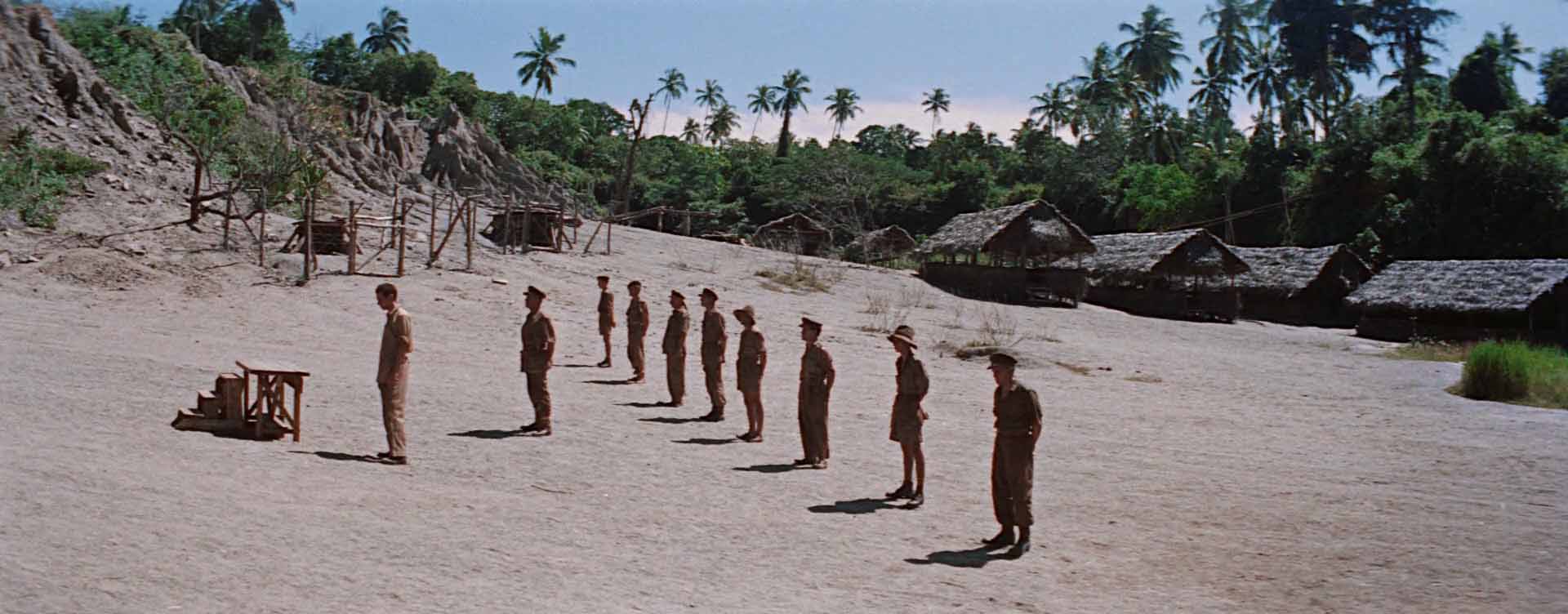
CinemaScope as 2.55:1
The movie was photographed in CinemaScope with 2x anamorphic lenses on 35 mm film.
In capture, the lens squeezes the image two to one. In projection, a matched lens stretches it back. Early prints often ran at 2.55:1 with four-track magnetic sound. The aspect ratio of scope has been revised since then.
The wide frame cannot hide sloppiness at the edges. The composition has to carry story, weather, and body language at once. The frame holds the bridge, the river, and a face in one breath.
CinemaScope also changes pace. The format rewards long takes, deep blocking, and rehearsal. It punishes lazy coverage. If you just park a camera and pan, the image goes flat.

Lenses from the makers of Ray-Ban
Bausch & Lomb engineered the production anamorphic lenses for Fox from Henri Chrétien’s Hypergonar idea. Early adapters could be twitchy. Faces would spread at close distance, the “mumps” crews still talk about. By the time The Bridge on the River Kwai was shot, refinements in focus and mechanics made the lenses predictable if you respected their limits.
Notice the frames don’t have oval bokeh or blue flares, and no soft edges. The jungle can turn into a wall of green mush if you shoot it flat. Cinematographer Hildyard’s plan avoids that. He lights skin and wood with the same respect, shapes the background with negative fill from foliage, and lets water and sky carry the highlights.

Look at the way Lean builds triangles. Nicholson, Saito, Clipton. Later, Shears, Warden, Joyce. Triangles lock power into the frame and let the camera float without losing the argument. When the actors move, the geometry shifts and the scene turns. The wide frame gives everyone room to be right and wrong in the same shot.
The lens and the staging also make closeups feel like decisions, not reflexes. You get medium shots that read like portraits because the world behind them is alive.
Eastmancolor stock has a clean, gently warm palette when you give it proper light. The film uses the tropical sun like a giant key and lets canopy shadow soften faces instead of chasing perfect fill. Khaki and olive pushed against blue-green river and sky give the frame its quiet color story.

Post production
Peter Taylor’s cutting is perfect. The worksite, the camp, the river bend, the commando approach, the wire, the detonator, the timing; it all reads on first pass. When the train appears, you are not asking the camera to spoon-feed you. The sequence lands like a piece of music because you already know your place.
Silence carries weight in The Bridge on the River Kwai. The sound design is great. My favorite is the sound of the train towards the end, but you don’t see it until the last minute.
When Malcolm Arnold’s score enters, it means something. The whistled “Colonel Bogey” is not a novelty. The counter-march stitches pride to routine until both sound the same.
Modern mixes love wall-to-wall underscore. If every moment is loud, nothing is. If you leave space, a drum hit counts.

What you can steal for your own film
Here are some notes:
- Put money where the lens can touch it. Build something or find something expensive to use as a backdrop.
- Use locations as arguments, not wallpaper. Write scenes that could only happen in that place.
- Choose an aspect ratio for story, not fashion. If you shoot wide, stage wide. Block in depth. Give the edges a job.
- Light for emotion and mood, not photographic perfection. The actors don’t have to look good. They have to look right.
- Let natural sound do the lifting before score arrives.
- Stage in layers. If you go anamorphic, understand the lens and format. Test close focus, horizontal stretch, and edge behavior.
Take risks that matter. The Hildyard story is not a daredevil anecdote. It is a reminder that point of view creates emotion. However, I don’t recommend you try anything like that. I don’t know what he was thinking.
Saying a movie looks like a billion bucks is a joke until it isn’t. The Bridge on the River Kwai feels paid for. The film is a masterpiece. It is also a filmmaking manual!
