
You might have seen this already, so it’s safe to skip. If not, please watch it to know what I think is good or bad with the camera, and what kinds of photography and videography it is suitable for.
Goals
Before reading and watching the review, it is important to first understand the goals of the review. The primary goal of this review is to say, definitely, whether this camera is an (or the) ideal choice for the following kinds of productions:
- Features films
- Short films
- Corporate videos
- Documentaries – feature length
- Documentaries – short length
- Wedding videos
- Music videos
- Commercials
- Sports
- Wildlife
- ENG/EFP
- Live events
The secondary goals of this review are:
- To understand the place of this camera in the grand scheme of things
- To know exactly what kinds of shots this camera cannot be used for
- To understand the differences in various picture profiles
- To understand the strengths of the camera
- To understand the S-Log2 workflow while shooting and in post production
A final goal of the review is to provide a general overview on the photographic abilities of the camera, with respect to:
- Photojournalism, event and street photography
- Wildlife photography
- Portrait, studio and fashion photography
- Fine art landscape photography
- Macro and product photography
I’ve left out 4K and external recorders. This will be dealt with in a later lesson.
Why did I buy the Sony A7s?
I bought the Sony A7s for the following specific use scenarios and conditions:
- Family, travel and street photography with manual focus
- 12 MP is more than enough for me
- Fully tactile controls in a lightweight body
- Low light photography and videography
- Silent shooting
- Frame guides and IRE for video
- Personal documentary and video projects in 1080p and 4K, without resorting to RAW recording
- To use my existing Nikon manual prime lenses, and not be platform bound
- A backup camera (not B-camera, though that might change) for corporate videos
- A ‘review’ camera for future wolfcrow reviews and videos!
Review of the features of the Sony A7s
Here’s my review of the Sony A7s:
The following is a summary of whatever I’ve covered above as it pertains to each feature:
APS-C mode
You get a crop factor of 1.5 and an “f-stop factor” (DOF and bokeh only, not true aperture, which remains the same) of 1.5 as well. E.g., a 50mm f/1.2 lens becomes a 75mm f/2 approximately. A 24mm f/1.4 becomes a 36mm f/2.4, and so on.
Audio quality
Really good and clean. Samples provided in above video.
LCD quality
Nice indoors, okay outdoors. Cannot use to judge colors, but which one can? Focus peaking works great.
The ‘blue’ channel clipping problem
Didn’t find it, though I tried blasting the blue channel into oblivion.
Rolling shutter
As bad as the first DSLRs that shot video. Better in APS-C mode. Not an issue for 90% of productions. Two problem areas:
- If you’re shooting moving blades, rotors, fast trains and out of cars, etc.
- If you’re whip-panning the camera like you have an epileptic seizure.
For most run-and-gun and shoulder-mounted work, it’s a non-issue. Shoot in APS-C mode during problem areas.
Resolution
Resolution varies across the board. Here’s a chart that compares resolution at different resolutions and frame rates (click to enlarge):
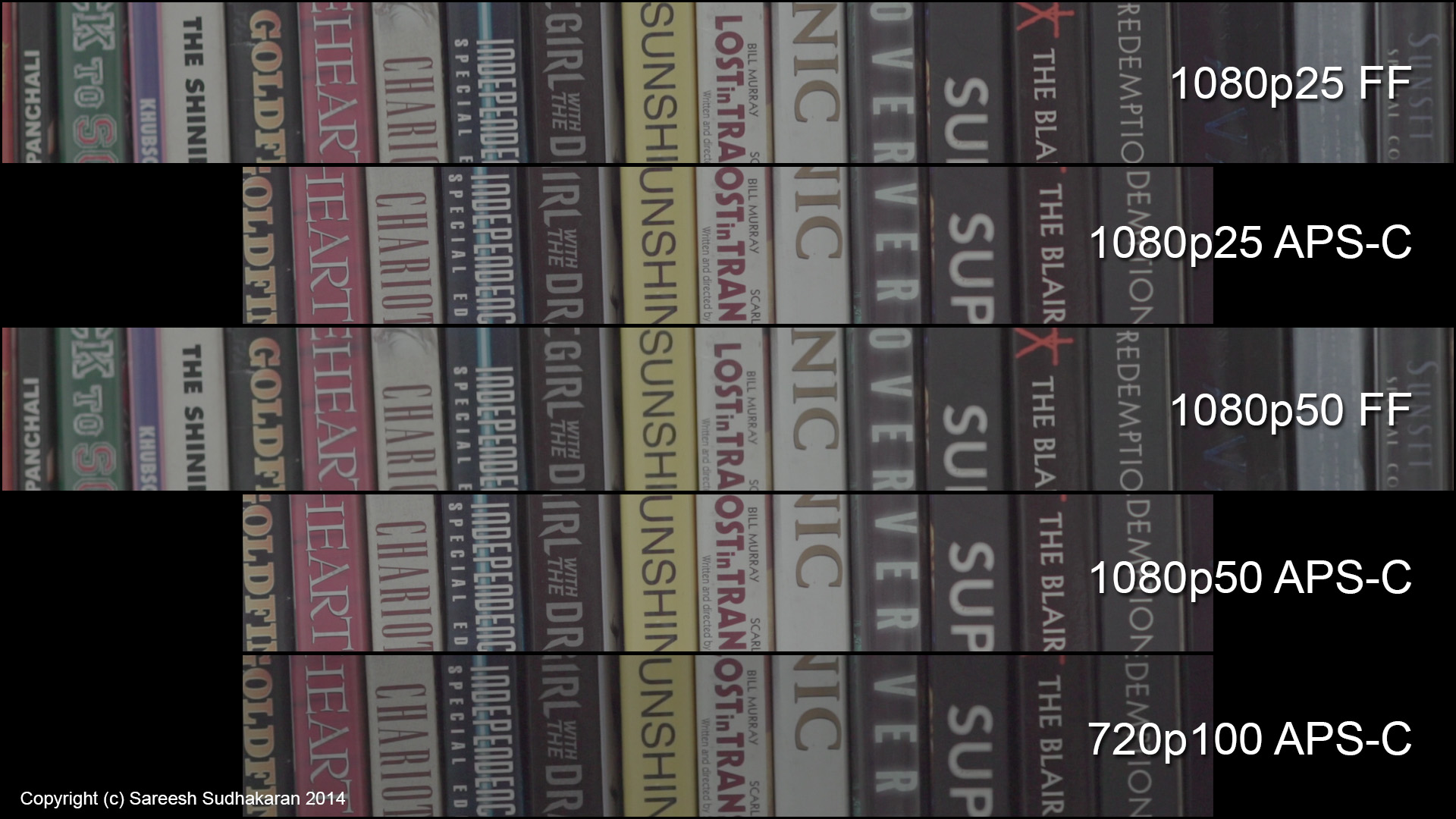
The camera has maximum resolution in full frame mode at 24, 25 and 30p. Even in APS-C mode, 1080p video is similarly sharp, so you can mix and match without any problems.
However, in 50p and 60p, the resolution is still 1080p, but as you can clearly see in the above image, it has lower resolution. In fact, it is worse than 720p! I cannot recommend using either 50p or 60p on the Sony A7s at this time. However, as a workaround, you could add a bit of sharpening in post.
In 100p and 120p, the resolution drops to 720p.
HDMI quality and options
Excellent options. Clean HDMI, full resolution. Can’t wait to try out 4K.
Weather protection
It is not weather-proof, but is weather resistant. I have shot in a light drizzle, and the camera has gotten wet, no issues. But Sony tells me it’s not weather-proof.
Manual Focusing
Excellent in both video and stills mode. Haven’t missed focus, even at f/1.2. What more can I say?
Aliasing and moire
Almost non-existent. A non-issue.
Banding at 8-bit or the 8-bit vs 10-bit debate
Stupid. Those who think there’s a difference have no clue about what they’re talking about. 8-bit is fine. Camera does not produce banding, If you see banding during grading, you’re not doing it right.
However, you can get posterization with the heavy compression found on Youtube or Vimeo. This is due to the color noise that effects the underexposed regions of the scene, and is a problem with most cameras.
Skin tones
Excellent. Filmic and organic, but you must know how to shoot and expose correctly.
ND filters @ISO 3200
The one big pain. But at least it’ll force me to buy that 4×4 filter set that’s long overdue. Couldn’t find any major IR radiation problems.
No good Sony lenses
The roadmap looks good, but I’m not buying a ticket until the whole park is completed. For now, I’m pretty pleased with my Nikon primes. Next up would be Zeiss CP.2 primes or whatever else the future has in store for us.
Poor battery life
Buy more batteries. Batteries drain out like there was a leak or something. Thankfully cheaper batteries exist.
You need a 64GB SDXC Card, even though it’s not “technically required”
Somebody at Sony was too lazy to program for SDHC cards. On the other hand, it’s quite easy to fill a 64 GB card anyway with XAVC.
AF with video
Excellent. I don’t use it, and I wouldn’t recommend using it, but it’s there, and it works.
Dynamic Range
I get a good usable 12 stops and that’s all I want. It’s filmic.
Low-light and ISO performance
The whole world knows the answer to this one, but if you don’t, then here it is: This is the number one low light consumer camera available for videography worldwide.
Camera settings for tests and footage
Here’s a quick summary of the camera settings used in the tests and footage in this review. All resolutions/frame rates are 1080p25 unless otherwise indicated. Camera shots were filmed using a Canon 550D and kit lens.
Intro sequence and various cutaways
Various settings. Graded in Adobe After Effects or left ungraded as indicated.
Me talking
- Creative Style: Off
- Picture profile: Cine4
- White balance: 3200K
- Color Mode: Cinema
Music Unltd concert
- Creative Style: Neutral
- Picture profile: Off
- White balance: Custom, done once
- Color Mode: Rec. 709 (Movie)
ISO range for this concert was between 12,800 and 25,600.
Picture profiles comparison
- Creative Style: Off
- Picture profile: As mentioned
- White balance: Cloudy
- Color Mode: As mentioned
Car Test (OneShot comparison)
- Creative Style: Off
- Picture profile: As mentioned
- White balance: 7100K custom
- Color Mode: As mentioned
Each shot was ‘corrected’ in DaVinci Resolve 11 Lite using the DSC Labs OneShot card. The gammas selected are displayed during the comparison. White point was 1.0 for some shots because they were underexposed. Except for the two overexposed shots of S-Log2 and 800% Rec. 709, all shots were exposed for the car in spot metering mode. The last two are with a ND8 filter and exposed for the car.
Anna kotta (elephant farm sequence)
- Creative Style: Off or Neutral
- Picture profile: S-Log2 or Off
- White balance: Cloudy
- Color Mode: S-Gamut or Movie
Many shots had an ND8 or even higher applied, as the case may be. There are also a couple of 720p shots in there. Aperture from f/5.6 to f/11, and one shot was f/1.2.
Who should use the Sony A7s?
Here are my suggestions for video, based on my personal knowledge, history and usage of this camera:
| Type of production | Recommended? | Alternative* | Better option?* |
| Feature films | Yes | Blackmagic Production Camera 4K | Blackmagic Cinema Camera 2.5K |
| Short films | Yes | Blackmagic Production Camera 4K | Blackmagic Cinema Camera 2.5K |
| Corporate Videos | Yes | None | Sony FS7 |
| Documentaries | No | Panasonic GH4 | Sony FS7 |
| Wedding videos | No | Canon 5D Mark III, Panasonic GH4 | Sony FS7 |
| Music Videos | Yes | Blackmagic Production Camera 4K | Blackmagic Cinema Camera 2.5K |
| Commercials | No | Blackmagic Production Camera 4K | Blackmagic Cinema Camera 2.5K |
| Sports | No | No | N/A |
| Wildlife | No | No | Sony FS7 |
| ENG/EFP/Run n’ gun | No | Panasonic GH4 | Sony FS7 |
| Live Events | No | No | N/A |
Here are my suggestions for photography:
| Type of photography | Recommended? | Alternative | Better option? |
| Street/PJ | Yes | Leica M | None |
| Wildlife | No | Sony A7r | Nikon D810 |
| Portrait/Fashion | No | Canon 5D Mark III | Medium format system with leaf shutter lenses |
| Fine art landscapes | No | Sony A7r | Nikon D810,Pentax 645z |
| Timelapses | No | Sony A7r | Nikon D810 |
| Astrophotography | Yes | Nikon D810 | CCD cameras with cooling |
| Macro and product | No | Sony A7r | Nikon D810 |
*Note: In a similar or ‘next’ higher price range.
Well, that’s the end of the Sony A7s review. I hope you have found it beneficial for the kind of productions you’re doing. You can see how it fit perfectly into my existing needs. But it’s not a camera for everyone.
FAQs
These are important topics raised by subscribers that shed more light on this lesson.
Q. Why don’t you recommend the A7s for weddings?
A. First, some background. I was invited to and attended the launch event for the A7s in Mumbai. The majority of those who showed up were from the wedding industry, which is only possible if Sony invited them. It was obvious who the focus was on.
I spoke to quite a few of them, and mind you, these guys are real pros shooting weddings with Epics and C300s, even DSLRs. Very few of them seemed excited about the A7s. For me, it was too early to understand why.
Here’s what I have learnt since then:
- Rigging is complicated – which means handheld shooting is tough. Compound this with the rolling shutter.
- To really get cinematic images, you would have to use S-Log2 or the 800% profile, both of which require color grading. As far as I know, when it comes to wedding business, there is hardly any time or money for grading – unless you’re doing real high-end work.
- Assuming one is happy with S-Log2 or 800%, then it demands the use of an external monitor. You don’t need it, but the majority of shooters will be nervous of exposing at +2 or +3 without a safety net.
- The autofocus only works with Sony lenses, but these lenses are not suited for video work. The new cinema zoom is a welcome option, though.
- There are no ‘light’ battery options, so you’re looking at a lot of charging, etc.
Lack of decent image stabilization is another issue, which Sony has solved with the A7II. - Low light work introduces noise, and it’s not something that edits well together with the other parts – this is purely a matter of taste.
It’s not like the camera is a deal breaker. Far from it. Those who are knowledgable enough to persist with the camera can and will make it work. My point was – it’s only if you make it work that it becomes better than the 5D Mark III (with Magic Lantern) or the GH4.
Last week I attended a high-end wedding where one of the B-cams was an A7s. The A-cam was a C300. The C300 is no slouch when it comes to low light shooting. I shot my own sister’s wedding reception with the A7s and one 50mm f/1.2 lens (stills only, no video). It’s an excellent camera all around.
The reality is, very few shooters go into this much depth. I didn’t want to add to the hype of the camera. Most reviews will have you believe it’s damn easy to get great images with the A7s, but it’s not – not without in-depth study and understanding. If you shoot in Movie mode or one of the Cine profiles, you’ll pretty much get something that a 5D3 or a GH4 can produce. The A7s only pulls ahead if you shoot S-Log2 and know how to grade it.
Click on the link below to the next lesson or head over to the main menu (above). If you need help with something, feel free to send me an email. I’ll try to get back to you as soon as possible.
